Wood science
Kiln drying of sawn timber: schedules, defects and quality control
Why sawn timber is dried, moisture targets (Eurocode 5, EN 14298 scope), kiln types, schedule logic, stress and defects, conditioning, energy and monitoring, with spruce/pine vs oak/beech contrasts. Sourced from FPL manuals and open European studies.
Country / region of the study or data: Europe and North America (one Australian source for vacuum drying)
Kiln drying is the step in a sawmill where much of the value is either secured or destroyed. A board that leaves the kiln at the right average moisture content, with a narrow spread between pieces, a small moisture gradient inside each piece and little residual stress can be planed, glued and installed without surprises. A board that leaves wet, overdried, case-hardened or checked becomes a claim or a regrade. This article covers the physics, the equipment, the schedule logic, the defects and the quality-control routines.
How to read this article. Every number below was read in a source opened during preparation (listed at the end). Region is marked: (North America) for USDA Forest Products Laboratory (FPL) and other US/Canadian material, (Europe) for European standards and studies, (Australia) where relevant. Statements labelled Own interpretation are the author's synthesis, not claims of the sources. Unverified points are listed in the closing sections. FPL temperatures are kept in degrees Fahrenheit, with approximate Celsius values (own conversion) only where helpful.
Why dry sawn timber
The USDA Dry Kiln Operator's Manual (North America) gives the reasons plainly. Removing water reduces weight and so shipping and handling cost. Proper drying "confines shrinking and swelling of wood in use". Dry lumber machines more precisely, holds fasteners and adhesives better and takes finishes more effectively. Uncontrolled drying causes warping, splitting and checking, and decay risk falls when wood is protected from excess moisture regain. The manual also states that fungi cannot grow at a moisture content of 20% or lower (it names 110 °F, about 43 °C, in the same sentence) and that temperatures above 150 °F (about 66 °C) are lethal to them.
Moisture basics
Moisture content and green wood
The FPL manual works on a dry basis: weight of water divided by weight of totally dry wood, times 100. Values can therefore exceed 100%. It gives a green moisture content range of roughly 30% to 200%, depending mainly on species. Sapwood and heartwood differ strongly. Wood Handbook Table 4-1 (North America) gives these typical averages:
| Species (North America) | Heartwood MC, % | Sapwood MC, % |
|---|---|---|
| Northern red oak | 80 | 69 |
| White oak | 64 | 78 |
| American beech | 55 | 72 |
| Sitka spruce | 41 | 142 |
| Loblolly pine | 33 | 110 |
The handbook stresses that variation within and between trees is considerable. A Swedish study (Hajian et al. 2023, Europe) measured starting moisture contents of Scots pine sapwood 107%, Norway spruce sapwood 95% and Norway spruce heartwood 35%. Own interpretation: a softwood charge starts with a wide moisture spread, so sorting by sapwood share, or at least controlling on the wettest pieces, matters.
Fibre saturation and EMC
The Wood Handbook states that the fibre saturation point (FSP) averages about 30% moisture content, with individual species and pieces differing by several percentage points. The FPL manual adds that cells do not shrink until FSP and that many properties begin changing there. For shrinkage calculations the Wood Handbook drying chapter assumes shrinkage starts at 30% for most species and at 22% for species flagged in its Table 13-5.
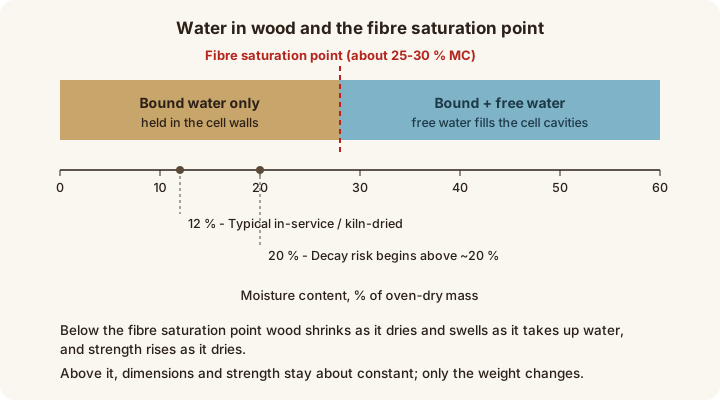
Above FSP, free water leaves the cell cavities without shrinkage. Below it, bound water leaves the cell walls, which costs more energy: about 5% more at 15% moisture content and about 15% more at 6% than free-water evaporation (FPL manual, North America).
The equilibrium moisture content (EMC) is set mainly by relative humidity and temperature. The kiln does not set moisture content directly; it sets an air state, and the wood moves toward the matching EMC.
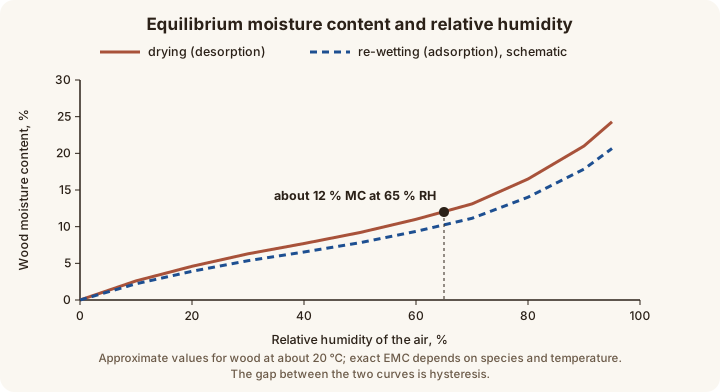
Two verified anchor points (North America): at 150 °F dry bulb and 130 °F wet bulb (depression 20 °F) the air is at 57% relative humidity and the EMC is 8% (FPL manual, Table 1-6); at 21.1 °C (70 °F) and 65% relative humidity, Wood Handbook Table 4-2 gives 12.0% EMC. The wet-bulb depression is the operator's practical handle on humidity: the larger it is, the drier the air and the lower the EMC.
Moisture targets and European classification
Three European document families are often mixed up.
Eurocode 5 service classes (EN 1995-1-1, Europe). As reproduced in the University of Galway Eurocode 5 handbook:
| Service class | Climate | Average MC of most softwoods |
|---|---|---|
| 1 | 20 °C; relative humidity above 65% only a few weeks per year | not exceeding 12% |
| 2 | 20 °C; relative humidity above 85% only a few weeks per year | not exceeding 20% |
| 3 | conditions giving a higher moisture content than class 2 | exceeds 20% |
A JRC Eurocode training presentation confirms the class 1 wording and notes that the Croatian national annex changes "a few weeks" to "two weeks" per year.
EN 335 use classes (Europe). EN 335:2013 defines five use classes concerning biological hazard (fungi, insects, marine borers). The publisher states that use classes and Eurocode 5 service classes both use wood moisture as a criterion but treat its effects differently, so they do not align one-to-one. Own interpretation: a kiln target should come from the service class and the product standard, not from a use-class number. The class definitions of EN 335 were not opened.
EN 14298:2017 (Europe). According to the scope text published by a standards reseller, the standard defines a method of assessment of drying quality for a lot of dried sawn timber (surfaced or not), softwood and hardwood up to 100 mm thick. Quality is expressed as moisture content: the target, the average for the lot and the variation between pieces. An optional case-hardening specification is included; checks, shake, warp and stain are excluded. The visible headings include "Sampling", "Moisture content", "Standard drying quality" and "Specific end-use drying", and an annex mentions a standard drying quality example of 12%. The sampling plan, sample sizes, tolerances and class definitions were not visible in any open source and are not given here.
For comparison, Wood Handbook Table 13-2 (North America) recommends average moisture contents (individual range in brackets):
| Use | Most US areas | Dry south-west | Damp warm coastal |
|---|---|---|---|
| Interior: woodwork, flooring, furniture, trim | 8% (6 to 10%) | 6% (4 to 9%) | 11% (8 to 13%) |
| Exterior: siding, trim, sheathing, laminated timbers | 12% (9 to 14%) | 9% (7 to 12%) | 12% (9 to 14%) |
The same chapter adds: softwood and hardwood framing about 15% average, not above 19%; softwood appearance uses 10 to 12%; cabinets and millwork 7 to 9%; hardwood furniture and cabinets 6 to 8%; laminations in one member within 5 percentage points. Own interpretation: both continents point the same way: interior joinery in the high single digits, structural and exterior softwood in the high teens with a ceiling near 19 to 20%. A European delivery must be specified from the product standard and contract.
Air drying versus kiln drying
According to the Wood Handbook (North America), lumber is commonly air-dried to 20 to 25% before kiln drying. Typical air-dried values are 20 to 25% for dense hardwoods and 15 to 20% for softwoods and low-density hardwoods; for much of the US the floor is 12 to 15%. Air-drying time to 20 to 25% for 25 mm lumber runs from 15 to 30 days for low-density species in favourable conditions to 200 to 300 days for slow-drying species in northern locations at unfavourable times. Pre-dryers run at 27 to 38 °C and 65 to 85% relative humidity.
Garrahan (2011, Canada) writes that each 1% reduction in moisture content before the kiln cuts the kiln load by about 40,000 BTU, or 8 million BTU per 1% on a 200 Mbf kiln, and that balsam fir in eastern Canada lost nearly 1% MC per day in spring and summer. Own interpretation: high-volume softwood mills that sell within days rarely air dry; slow, valuable species and thick stock gain most from controlled air drying or pre-drying, which removes water from the easy part of the curve above FSP.
Kiln types
Classification
The FPL manual (chapter 2, North America) classifies kilns by operating technique, temperature and energy source.
| Class | Typical operating range | Reference maximum |
|---|---|---|
| Low temperature | 70 to 120 °F | 120 °F |
| Conventional | 110 to 180 °F | 180 °F |
| Elevated | 110 to 211 °F | 211 °F |
| High temperature | 230 to 280 °F | above 212 °F |
FPL-GTR-57 describes high-temperature schedules as usually 230 to 250 °F, with possible strength losses and "very species dependent" for hardwoods. The Wood Handbook splits differently: conventional below 100 °C, high-temperature above 110 °C. Own interpretation: class boundaries differ by source, so ask a supplier for the actual dry-bulb values.
Conventional kilns
Kilns are track-loaded (trucks on rails; most US softwood) or package-loaded (forklifted stacks; common for hardwood). The FPL manual gives track kilns 6 to 9 ft stack width per track, 40 to 66 ft length for hardwood and 66 to 120 ft for softwood, with about 25,000 to 220,000 board feet capacity (4/4 to 8/4); package kilns are usually 24 ft deep with about 25,000 to 90,000 board feet. Generally (author's wording), a conventional kiln heats air, circulates it through the stickered stack with fans and vents humid air to control humidity.
High-temperature kilns
Garrahan (Canada) reports that high-temperature kilns can dry in half the time or less, and cites a southern pine study with a 13% energy reduction. The cost is quality. Frühwald (Lund University, 2007, Sweden) compared 80 °C conventional with 120 °C and 170 °C drying of Norway spruce and larch: bending strength decreased with drying temperature, stiffness was largely unaffected, toughness showed no clear trend, shape stability was similar, and mould growth was about equal for all kiln temperatures and lower after air drying. Borrega (2011, Finland) dried Norway spruce at 110, 120 and 130 °C in a pressure vessel; specific bending strength was unchanged for mass losses up to 6%. Own interpretation: strength effects depend on temperature, moisture state and time; do not assume strength neutrality without your own test data.
Dehumidification kilns
A dehumidification kiln removes water by condensing it on cold coils instead of venting humid air; the Wood Handbook says they are usually package-loaded. Garrahan says they can use up to 50% less energy than conventional kilns, but mostly electricity, which costs more than thermal energy, so they suit smaller operations or where alternative energy is expensive. Own interpretation: the case depends on the price of electricity relative to the residue-based heat a sawmill may already produce.
Vacuum kilns
An Australian report (Redman 2011, Australia) describes a 2 m³ superheated-steam vacuum kiln at 0.1 to 0.2 bar, where water boils around 45 °C, with a steam-air mixture at 40 to 80 °C. For equivalent quality it reports drying in 41 to 66% of the conventional time, depending on species, and notes that heat must still be supplied because low pressure weakens external heat transfer. A Romanian paper (Câmpean and Lăzărescu 2016) cites superheated-steam vacuum drying at 2.5 to 3 times faster than conventional drying and high-frequency/vacuum drying of 25 mm oak from 50% to 8% in about 15 days.
A Hungarian plant case (Kocsis and Németh 2026, Europe) compared convective and vacuum drying of 28 mm oak from about 45 to 55% to 10%: convective cycles took 20 days (summer) and 25 days (winter); vacuum took 4 to 5 days. Annual average thermal energy was about 1560 MJ/m³ convective against about 1000 MJ/m³ vacuum, but electricity was about 45 kWh/m³ against 176 kWh/m³. Own interpretation: vacuum shifts energy from heat to electricity and cuts time sharply; this is one plant, and no source opened quantified capital cost.
Schedules: dry bulb, wet bulb and stages
What a schedule is
The FPL manual (chapter 7) calls a kiln schedule "a carefully worked-out compromise" between fast drying and avoiding defects: a series of dry-bulb and wet-bulb temperatures applied at stages of drying, limited by drying stresses. The wet-bulb setpoint is the dry-bulb setpoint minus the depression. Hardwoods are usually dried by moisture-content schedules (settings change when the controlling samples reach given moisture contents); softwoods usually by time schedules (settings change after set periods).
The T and C code system (North America)
Each species and thickness has a temperature code T (T1 to T14, Table 7-1) and a depression code C (Table 7-2). For 4/4 sugar maple (T8-C3) the moisture steps are above 40, 40, 35, 30, 25 and 20%, and depression schedule 3 gives 5, 7, 11, 19, 35 and 50 °F; temperature changes wait until the controlling samples reach 30%. (The T8 dry-bulb values could not be read reliably and are not quoted.) Examples from Table 7-7: upland red oak T4-D2 for 4/4 to 6/4 and T3-D1 for 8/4; white oak T4-C2 and T3-C1. FPL-GTR-57 indexes eastern white pine 8/4 as T10-C4 and regular southern pine 4/4 to 5/4 as T13-C6.
Stage logic
- Early stage. Keep initial temperature low and humidity high to protect surface strength of wet wood; hold initial temperatures until the controlling samples reach 30%. For softwood brown-stain control the initial dry bulb should not exceed 120 °F.
- Humidity down. Relative humidity can be lowered gradually after about one-third of the green moisture content is lost.
- Temperature up, late. Temperature generally cannot be raised until the average reaches about 30%. After the controlling samples reach 15 to 20%, 200 °F or more is usable and many hardwoods can finish at up to 230 °F. Mid-drying dry-bulb increases are the most dangerous change because of honeycomb risk.
- Equalise and condition (below).
Limits for treated wood: waterborne preservative-treated wood not above 190 °F; fire-retardant-treated not above 160 °F.
Adjustments described in the chapter: shift to a higher moisture class when green moisture is near the top of its class (4/4 northern red oak at 95% dried on E2 instead of D2 saved 4 to 5 days); use the next higher depression schedule at the cost of minor checks; use H-type schedules above 140% green moisture; for mostly sapwood raise T by 1 or 2 (about 10 °F). Doubling thickness increases drying time by a factor of about 3 to 3.5.
A European oak example
Câmpean and Lăzărescu (2016, Romania) recommend for conventional oak drying: at or below 30 to 40 °C until the critical moisture content of 27%, EMC as high as possible (stated about 18%), air velocity up to 2 m/s; below 27% raise to 60 °C (70 °C for timber up to 40 mm) with a drying gradient of 1.5; for equalising and conditioning lower to 50 °C and spray until EMC reaches 10 to 12%. Their 2 m³ trial dried 40 mm Quercus robur from 50% in 700 hours with few surface checks and no internal checks or discoloration. The Hungarian plant used roughly 40 to 45 °C dry bulb with EMC about 12 to 15% early and 60 to 65 °C with EMC about 6 to 8% at the end.
Own interpretation: the T/C system is North American. No commercial Swedish, Finnish or German schedules were available in open sources, so none are tabulated.
Drying stresses and shrinkage
The Wood Handbook (chapter 13) explains the mechanism. Stresses arise from differential shrinkage between shell and core. Early in drying the shell is in tension and the core in compression; if the shell dries too fast it can set and check. Later the stresses reverse and the core goes into tension, which can cause internal cracks (honeycomb). Schedules must keep stress below wood strength at each temperature and moisture level.
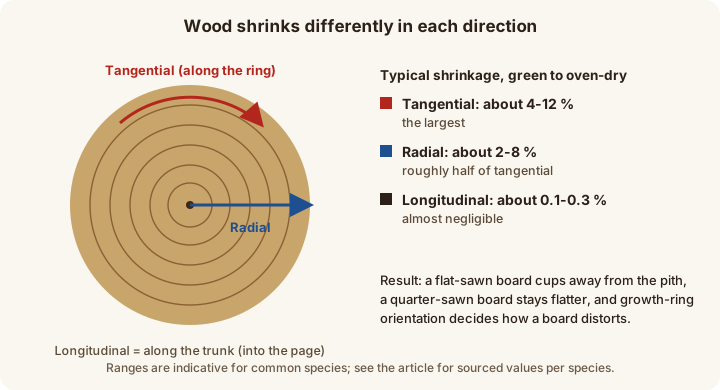
Wood Handbook Table 4-3 (North American species, green to ovendry, % of green dimension):
| Species | Radial | Tangential | Volumetric |
|---|---|---|---|
| Northern red oak | 4.0 | 8.6 | 13.7 |
| White oak | 5.6 | 10.5 | 16.3 |
| American beech | 5.5 | 11.9 | 17.2 |
| Sitka spruce | 4.3 | 7.5 | 11.5 |
| Loblolly pine | 4.8 | 7.4 | 12.3 |
Own interpretation: tangential shrinkage is about 1.5 to 2.2 times radial in this table (own calculation). That ratio makes flatsawn boards cup and rays tear, and the dense, high-shrinkage hardwoods demand gentler schedules. European species values were not opened.
Defects
The FPL manual (chapter 8, North America) gives cause and remedy for each defect.
| Defect | Main cause | Main remedy |
|---|---|---|
| Surface check | Surface dries too fast, humidity too low | Higher humidity early; do not wet checked lumber |
| End check | Lengthwise moisture movement; ends dry first | High humidity early, end-coat green ends, stickers at ends |
| Honeycomb | Internal tension failure, usually in rays; high temperature while core is above FSP | No temperature rise until core is below FSP |
| Collapse | Cell flattening, "generally associated with excessively high dry-bulb temperatures early" | Low initial temperature, air drying first, reconditioning |
| Case hardening | Unbalanced residual stress | Conditioning |
| Warp | Differential shrinkage, grain, reaction wood | Good stacking, sawing pattern |
| Sticker stain | Moisture under stickers, fungi, oxidation | Dry, narrow or grooved stickers; airflow of at least 200 ft/min |
| Brown stain (softwood) | Oxidative and enzymatic reactions of sapwood chemicals | Low dry bulb, large depression, steaming, antioxidants |
Details worth adding: reconditioning of collapse by steaming near 212 °F and 100% relative humidity at about 15% average moisture content for 4 to 8 hours removes much excess shrinkage but corrodes kilns. Cup comes from tangential versus radial shrinkage; bow and crook from longitudinal differences (juvenile, tension or compression wood, cross grain); twist from spiral or interlocked grain; stacking helps less for bow and crook. Frühwald found that restrained drying or top loading reduced twist in spruce, and the effect persisted under changing humidity.
On discoloration the manual notes that southern pine browns above 160 °F and that steaming green wood to 212 °F inactivates the enzymes; hickory sapwood turns pinkish in kiln drying (so low initial temperatures are needed), and hard maple sapwood darkens if dried too hot. Blue stain and mould feed on sapwood sugars; chemical treatment should follow sawing within about 36 hours; tan mould on oak heartwood appears under warm, humid, poorly ventilated conditions. Iron stain forms in wetwood where bacterial acids react with iron, steel or zinc, and steam condensate can cause iron-tannate stains. For uneven final moisture content the manual recommends presorting on the green chain; otherwise sort after drying and redry wet boards, which can add 25% or more to drying cost. It defines boards at 20% or above as unseasoned and softwood below 10% as overdried.
A Slovak-Polish beech study (Barański et al. 2017, Europe) measured the colour change after drying at 100 to 120 °C: ΔE of 13.4 to 14.1 for red false heartwood and 14.9 to 16.5 for sapwood, which the authors explain by sapwood being lighter.
Moisture gradient, case hardening and conditioning
Moisture gradient. The FPL shell-and-core test (chapter 6) cuts a 1 inch moisture section, divides it into shell and core, and oven-dries each. It is best made at an average of about 20 to 25%. For oak, delay raising the kiln temperature in the final steps until core moisture content is 25% or lower, to avoid honeycomb. In the Slovak beech study the gradient rose from 0.33 to 2.63% before to 7.8 to 13.25% after drying (all graded quality degree 3). In its covering-slicing (cup) stress test, red heartwood showed 1.05 to 1.06 mm before and 8.58 to 9.09 mm after drying, sapwood 0 mm before and 9.13 to 9.2 mm after. The paper has internal inconsistencies (for example 24 + 8 h versus 36 h total time), so treat these values as illustrative.
Prong test. Lumber under 1.5 inches thick is cut into three prongs and the middle prong removed; thicker lumber is cut into six prongs with the second and fifth removed. Outer prongs pinching inward indicate case hardening, because core tension is released. Severe stress makes prongs touch or snap together; in the offset version crossing prongs indicate severe stress. Residual stress causes immediate movement; moisture-gradient movement takes hours.
Equalising and conditioning (chapter 7). Equalising starts when the driest kiln sample is 2 percentage points below the desired final average; the equalising EMC is set at that value and runs until the wettest sample reaches the desired average. Conditioning relieves residual compressive shell stress with high temperature and humidity: EMC 4 points above the desired final moisture content for hardwoods and 3 points for softwoods, at 160 to 180 °F for 16 to 24 hours for 4/4 hardwood and up to 48 hours for 8/4; some 4/4 softwoods need as little as 4 hours. Conditioning is generally applied for final moisture contents of about 5 to 11% and is not really necessary for softwood dimension lumber dried to 15% average (maximum 19%). The case-hardening test is the most exact check.
Own interpretation: the lower the final moisture and the more asymmetric the later machining, the more stress relief matters. EN 14298's optional case-hardening specification fits this logic, but its procedure was not verifiable.
Spruce and pine versus oak and beech
| Aspect | Spruce and pine | Oak and beech |
|---|---|---|
| Control method (FPL, NA) | Normally time schedules | Normally moisture-content schedules |
| Green MC pattern | Very wet sapwood, drier heartwood (Swedish pine sapwood 107%, spruce heartwood 35%) | Less contrast in NA data (red oak 80/69, beech 55/72 heartwood/sapwood) |
| Volumetric shrinkage (NA data) | 11.5 to 12.3% | 13.7 to 17.2% |
| Temperatures in sources | Studies up to 170 °C for spruce | Oak 30 to 40 °C at start (Romania) |
| Typical risks | Twist, brown stain, strength loss at high temperature | Checks, honeycomb, collapse, discoloration, iron stain |
| Time in sources | No softwood cycle time in the sources opened | Oak 20 to 25 days in Hungarian plant; 700 h in Romanian trial |
Hajian et al. found that schedules designed for Norway spruce and Scots pine did not suit western hemlock: hemlock heartwood had wet pockets and moisture gradients up to six times higher than spruce in some sections, and the authors recommend sorting by sapwood and heartwood content. Own interpretation: a schedule is calibrated to a raw material; changing species or sapwood share without recalibration invites defects. Câmpean and Lăzărescu attribute oak's difficulty to its ring-porous structure, large rays and tannin-related discoloration. In beech, red false heartwood has more tyloses, which lower permeability and slow drying (Barański et al.); own interpretation: it is therefore sensible to sort or dry it separately.
Energy use
Garrahan (2011, citing a 2009 Athena Institute and FPInnovations study, Canada) gives total softwood lumber energy of 1,514 MJ/m³, of which drying is 1,000 MJ/m³, about two-thirds. Evaporation takes 60 to 70% of softwood drying energy. Fan electricity is 5 to 10% of drying energy but up to 20% of energy cost; better fans and adjustable speed drives cut electricity use 30 to 40%. A theoretical benchmark is about 1.6 kWh per kg of water removed in a conventional kiln.
For oak, Câmpean and Lăzărescu state 560 to 700 kWh/m³, or 2.7 to 4.0 kWh per kg of water, for conventional drying. The Hungarian plant measured thermal energy of about 1089 MJ/m³ in summer and 2312 MJ/m³ in winter for 28 mm oak, with electricity of 10.7 and 56.1 kWh/m³. At 1 kWh = 3.6 MJ these thermal values are about 302 and 642 kWh/m³ (own conversion). Own interpretation: the figures are not comparable directly (species, thickness, system boundaries differ), but show hundreds of kWh of heat per cubic metre, a large winter penalty in a poorly insulated plant, and a gap between the theoretical benchmark and reported oak values.
Measures named in the sources: better chamber insulation and heat recovery or condensation systems (Hungary); heat exchangers preheating incoming air to within 10 to 20 °F of kiln temperature, fan drives, uniform and presorted charges, controlled air drying, in-kiln moisture detection and energy benchmarking (Garrahan).
Monitoring and sensors
The FPL manual (chapter 6) describes kiln samples at least 30 inches long, with 1 inch moisture sections cut from each end, weighed to 0.5% and oven-dried at 214 to 221 °F (101 to 105 °C), usually for 24 to 48 hours. At least four samples are advised for charges of 20,000 board feet or less and usually 10 to 12 for charges of 100,000 board feet or more; for hardwoods 10 to 12 samples from green to 40%, 20 to 23 from 40 to 12%, and 7 to 12 from 12 to 6%. Under the recommended schedules, conditions change when the average of the wettest 50% of the samples reaches the scheduled value; equalising starts on the driest sample.
Resistance probes are limited in accuracy above 30%, because resistance changes little there; charges are dried to about 30% by another method and probes control the rest. Automatic options include probes needing no sample cutting and miniature load cells that weigh boards continuously. The manual gives no numerical meter accuracy. Samples should sit near the top and bottom of stacks on both sides, spaced 10 to 16 ft along the kiln; slow samples reveal cold or low-circulation zones, fast samples hot or high-circulation zones, and the rate difference between entering-air and leaving-air sides shows how often to reverse airflow. Own interpretation: the weak point is often sensors and load quality, not the controller; the manual notes about 4% drying-time change per 1/32 inch of thickness variation in 1 inch red oak.
Quality control routine
The steps below are the author's synthesis.
- Define target and tolerance before the run from the product standard and contract (frames: 12% and 20% for service classes 1 and 2; 8% interior, 12% exterior in North American tables; framing at most 19%).
- Sort by species, thickness and sapwood share.
- Control with representative samples, placed in the slowest and fastest zones.
- Run the stages deliberately: low temperature early, humidity down after one-third of green moisture is lost, temperature up only when the core is safe.
- Equalise and, where needed, condition; check with prong and shell-and-core tests.
- Assess the lot at unloading by mean and spread, as EN 14298 frames it (sampling plan not verified).
- Log curves and results, and keep them for claims and schedule corrections.
Sources used
All sources were opened during preparation.
- USDA FPL, Dry Kiln Operator's Manual (Agriculture Handbook 188), introduction, chapters 1 and 2 (NAU copy). North America.
- Same manual, chapter 7, Kiln Schedules (woodweb copy). North America.
- Same manual, chapter 6, Kiln samples and moisture content determination (woodweb copy). North America.
- Same manual, chapter 8, Drying defects (woodweb copy). North America.
- USDA FPL, Wood Handbook chapter 13 (FPL-GTR-190). North America.
- Wood Handbook chapter 4 Moisture relations and physical properties (CED Engineering copy). North America.
- EN 14298:2017 scope text (iTeh catalogue page). Europe.
- JRC Eurocodes workshop presentation on EN 1995 (Rajcic). Europe.
- Design of timber structures, Volume 2, University of Galway. Europe.
- DIN EN 335:2013 product description (DIN Media). Europe.
- Kocsis and Németh (2026), Drvna industrija 77(2). Hungary.
- Hajian et al. (2023), Applied Sciences 13(19). Sweden.
- Borrega (2011), Dissertationes Forestales 134. Finland.
- Frühwald (2007), doctoral thesis abstract, Lund University. Sweden.
- Redman (2011), super-heated steam vacuum drying report. Australia.
- Garrahan (2011), Wood Business. Canada.
- Barański et al. (2017), BioResources 12(1). Slovakia and Poland.
- Câmpean and Lăzărescu (2016), Bulletin of the Transilvania University of Brasov. Romania.
- Boone et al. (1988), FPL-GTR-57, index tables. North America.
- Conners, Hardwood Dry Kiln Operation, University of Kentucky Extension. North America (the air-dried floor of 12 to 15%).
Limits of this article
- EN 14298 sampling, sample sizes, tolerances and classes are not verified; only scope text and headings were visible.
- EN 335 class definitions and EN 14081 moisture requirements were not opened.
- No commercial European (Swedish, Finnish, German) schedules were available in open sources. The T/C system and its examples are North American, and the T-series dry-bulb values could not be read and are not quoted.
- Shrinkage, green moisture and EMC tables are for North American species; values for European oak, beech, spruce and Scots pine were not verified.
- The copy of the Operator's Manual used for chapters 1 and 2 was truncated; chapters 6 to 8 came from separate copies.
- Energy figures are case-specific and not directly comparable; kWh conversions are the author's arithmetic. Capital cost and payback of dehumidification and vacuum kilns were not found.
- The beech study has internal inconsistencies and a small sample; strength losses from high-temperature drying were available only from abstracts and theses without numbers.
- Sensor accuracy is not quantified in any source opened.
- This is a synthesis for general information, not a substitute for standards, supplier advice or a trial on your own kiln.
How this text was checked · checked 2026-10-26
Each cited figure read on the opened source pages (USDA FPL manual chapters and Wood Handbook, EN/Eurocode descriptions, open papers); region labelled; own interpretations labelled; unverifiable items listed.
Could not be verified
- EN 14298 sampling plan, sample sizes, tolerance limits and quality classes (only scope text and headings seen)
- EN 335 individual use-class definitions and EN 14081 moisture requirements (not opened)
- Commercial Swedish/Finnish/German kiln schedules (none found in open sources)
- Dry-bulb values of FPL T-series schedules (table unreadable in extraction)
- Shrinkage, green MC and EMC values for European oak, beech, spruce, Scots pine (only North American species tables used)
- Numerical strength loss from high-temperature drying (abstract-level sources only)
- Capital cost and payback of vacuum and dehumidification kilns
- Numerical accuracy of in-kiln moisture sensors
- Operator's Manual copy for ch. 1-2 was truncated; ch. 6-8 read from separate copies
- Beech study internal inconsistencies (total drying time, covering conclusion vs table)
Sources
- USDA FPL Dry Kiln Operator's Manual (Ag. Handbook 188), intro, ch. 1-2 (NAU copy)
- Dry Kiln Operator's Manual, ch. 7 Kiln Schedules
- Dry Kiln Operator's Manual, ch. 6 Kiln samples and moisture content determination
- Dry Kiln Operator's Manual, ch. 8 Drying defects
- Wood Handbook ch. 13 Drying and control of moisture content (FPL-GTR-190)
- Wood Handbook ch. 4 Moisture relations and physical properties (CED Engineering copy)
- EN 14298:2017 Sawn timber - Assessment of drying quality (scope, iTeh catalogue)
- Rajcic, EN 1995 (Eurocode 5), JRC Eurocodes workshop
- Design of timber structures, Volume 2, Eurocode 5 rules and formulas (Univ. of Galway)
- DIN EN 335:2013 use classes (DIN Media description)
- Kocsis & Nemeth (2026), Energy efficiency of industrial wood drying, Drvna industrija 77(2)
- Hajian et al. (2023), Drying behaviour of western hemlock with schedules for Norway spruce and Scots pine, Applied Sciences 13(19)
- Borrega (2011), Dissertationes Forestales 134, heat-treated and high-temperature dried Norway spruce
- Fruhwald (2007), Effect of high-temperature drying on spruce and larch, Lund University
- Redman (2011), Evaluation of super-heated steam vacuum drying viability (FWPA, Australia)
- Garrahan (2011), How energy efficient is your drying operation?, Wood Business (Canada)
- Baranski et al. (2017), High temperature drying of beech wood, BioResources 12(1)
- Campean & Lazarescu (2016), Considerations upon the drying of oak lumber, Bull. Transilvania Univ. Brasov
- Boone et al. (1988), Dry kiln schedules for commercial woods (FPL-GTR-57)
- Conners, Hardwood Dry Kiln Operation, University of Kentucky Extension
Last updated 2026-10-26