Wood science
Engineered Wood Products and What They Need from Sawmills
How glulam, CLT, LVL, plywood, OSB, finger-jointed timber and I-joists are built, what lamellas and boards each requires (thickness, grade, moisture), why yield and grading matter, European market trends 2023-2025, and how a sawmill can supply lamellas. European and North American data marked.
Country / region of the study or data: Europe (Swedish Wood; Holzkurier market data for DACH region, Italy, Czech Republic 2023-2025; EPF panels; EN 14080 and EN 16351 scope); North America (Virginia Tech CLT, Oklahoma State LVL and OSB); Australia (WoodSolutions CLT)
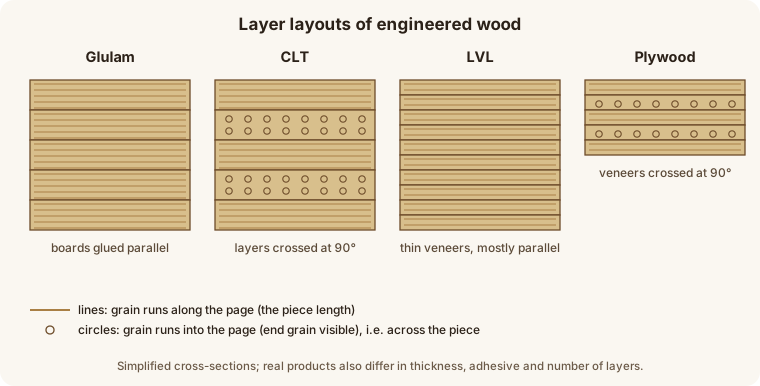
Schematic layer layouts: glulam and LVL keep every layer parallel to the member axis, while CLT and plywood alternate the grain direction between layers.
Why this matters in the sawmill
Engineered wood products (EWP) are the main outlet that turns ordinary sawn softwood into higher-value building components, and for many European mills they are the reason to invest in grading, finger jointing or drying capacity. A sawmill can take part at three levels: selling dried, strength-graded boards to a glulam or CLT plant; finger-jointing and planing its own lamellas; or integrating further into the product. Each level moves the risk. The lowest level still demands a specific moisture, thickness and grade, and the plants that buy lamellas are strict because a delivery that does not meet the specification costs them press time and glue.
This article explains how glulam, CLT, LVL, plywood, OSB, finger-jointed timber and I-joists are built, what each asks of the sawn input, and what the market looked like in the sources used (trade-press figures dated January 2024 to December 2025, checked on 26 October 2026). Data are marked European (Swedish, Austrian and German sources) or North American (Virginia Tech and Oklahoma State University extension sheets), because lamella dimensions and grading rules differ. One Australian source is also used. The full text of the European standards for glulam and CLT was not opened, so only their scope-level limits, seen in standards catalogue pages, are quoted; tolerances and test limits are deliberately not quoted, and no yield percentages are given because none of the open sources read stated one.
Glulam: parallel laminations
Glued laminated timber is built from graded boards, finger-jointed to length, planed, glued face to face and pressed, with the grain running parallel in every layer. A Swedish industry source (Swedish Wood; European) gives 45 mm finger-jointed laminates to EN 14080 as the basis of Swedish glulam, with the standard Swedish grade GL30, lengths in stock up to 12 m, mainly spruce, and melamine-urea-formaldehyde adhesive (Type I) at under 1% of the weight. EN 14080:2013 itself covers glulam laminations from 6 mm up to 45 mm thick (scope seen in a catalogue listing; a newer edition may exist and was not checked). In the combined type (GL30c) there are at least four layers, with T22 laminations in the outer zones and T15 in the inner zone, the outer laminations amounting to 2 x 17% of the beam height; glulam with a height of 180 mm or more falls into GL30c. The homogeneous type (GL30h) is used below 180 mm height and has fewer than four layers; that it uses T22 throughout was not re-found in the page text and is unverified. Split beams (width under 90 mm) are designated GL28cs and lose up to 2 MPa in strength from splitting. The "T" classes are tension grades for the boards; the idea is that the strongest laminations sit where bending stresses are highest.
The Australian WoodSolutions page (see CLT below) notes that European CLT lamellas are commonly around 40 mm. The real variation is therefore about 40 mm in some plants and 45 mm in others (our reading of two different product types), and the sawmill must always ask which cut dimension and planed thickness a given plant uses. No verified gluing-moisture figure for glulam was obtained; the CLT sources below cite about 12%, and the glulam plant's own window should be requested.
Finger joints
Finger joints extend short boards to the lengths needed. The Swedish source stresses that milling the fingers requires considerable precision, and that the laminations are strength-graded before assembly. The detailed finger-joint requirements (profile length, strength factors, test frequency) sit in the product standard, EN 14080 for glulam, which Swedish glulam must meet; the scope of the 2013 edition covers large finger joints in glulam with a finger length of at least 45 mm. The standard text was not opened, so its other numbers are not quoted. What a sawmill can say from experience is that the quality of the cut ends (square trimming, no crushed fibre, no wane in the joint zone) and uniform moisture on both sides of the joint determine whether the joint passes; that is general craft knowledge, not a figure from the sources.
CLT: crossed layers
Cross-laminated timber consists of boards glued side by side in a layer, with each layer turned 90 degrees to its neighbour. The Swedish structural-elements page (European) gives boards 20 to 60 mm thick, three, five or seven layers as typical (its table lists 3, 5, 7 and 9, up to 25 available), panel thicknesses commonly 80 to 300 mm (60 to 500 mm available; three-layer panels normally 60 to 120 mm), widths commonly 1.20 to 3.00 m (up to 4.80 m) and lengths commonly 16 m (up to 30 m). The largest panel mentioned is about 3.5 by 20 m. The same page states a target moisture content of 12%, with delivery up to 16%. The European CLT standard EN 16351:2021 (Europe; scope seen in a catalogue listing, replacing the 2015 edition) covers layers of nominal thickness 6 to 47 mm made of strength-graded timber to EN 14081-1 and laminations of nominal width 40 to 300 mm, with a maximum overall thickness of 500 mm, at least three orthogonal layers and use in service class 1 or 2.
The North American extension sheet (Virginia Tech, referring to ANSI/APA PRG 320 and PS 20; edition of the standard not checked) gives lumber 15.9 to 50.8 mm thick, 60.96 to 241.3 mm wide, kiln-dried to 12 plus or minus 3%. Softwoods must have specific gravity greater than 0.35; parallel layers use visually graded No. 2 lumber and perpendicular layers No. 3, with machine-stress-rated 1950f-1.7E appearing in the parallel layers of some CLT grades. The boards are finger-jointed, surfaced on four sides and trimmed. The Australian WoodSolutions page lists lamellas of typically 20 to 45 mm (about 40 mm common in Europe), widths 60 to 250 mm, machine strength grading before assembly with substandard boards rejected or used non-structurally, and moisture of about 12 plus or minus 2% for boards and the finished panel. It names polyurethane (PUR) and melamine-urea-formaldehyde (MUF) adhesives; PUR is described as one-component, moisture-curing and formaldehyde-free with a nearly invisible glue line, while MUF has a darker, more visible glue line and contains formaldehyde that must be managed. The draft's claim that PUR is the most common system in European and Australasian production was not found on the page and is unverified.
For the sawmill, the grading implication is that a CLT customer may accept a wider spread of grades than a glulam customer, since the North American rules allow lower grade (No. 3) in the perpendicular layers, and EN 16351 requires strength-graded layers. Whether a European plant accepts lower grades in inner layers is a plant specification; the draft's statement that the Swedish source puts higher-strength boards in the surface layers was not found in the page text read and is unverified. How much of a mill's output falls in each fraction depends on the logs and the grading machine, and no verified figure is available.
LVL: veneer laid parallel
Laminated veneer lumber glues thin rotary-peeled veneers with the grain parallel along the length. The Oklahoma State sheet (North American) gives veneer thicknesses of 2.5 to 4.8 mm (typically 3.2 mm), drying (for 3 mm Douglas fir) to 8 to 10% moisture content, a usually phenol-formaldehyde adhesive, and pressing at 250 to 450 degrees Fahrenheit (about 120 to 230 degrees Celsius), in presses that are longer than plywood presses, most mills using a continuous press line. Douglas fir is the most common species in the US; radiata pine is used in New Zealand and rubberwood in Southeast Asia. The Swedish page (European) describes beams of at least five layers of pine or spruce veneer, each up to 6 mm, bonded with phenolic resin, standard beams 45 to 75 mm wide, 200 to 500 mm deep and 4 to 12 m long, with 10 plus or minus 2% moisture at delivery, and sheet LVL of at least seven layers of about 3 mm with density about 500 kg/m³.
LVL is a veneer product. A sawmill does not feed it directly, but it matters as a competitor and as a partner: logs that suit veneer peeling (straight, large-diameter, low-knot) are not sawn into lamellas. Mills that also hold a peeling line or sell logs to one decide the log split between sawing and peeling. No numbers for veneer-grade log requirements are given in the open sources used.
Plywood and OSB: panels
Plywood alternates the veneer grain direction layer to layer (conventionally with an odd number of veneers, which is general knowledge and not stated in the sheets used); the Oklahoma State LVL sheet says this gives plywood better dimensional stability, whereas LVL aligns all veneers lengthwise and behaves more like solid lumber. OSB is made from strands rather than veneers. The same Oklahoma State series (North American) gives strand dimensions of about 0.5 by 3 by 0.02 inches, dried from 40 to 75% moisture to 5 to 10%, bonded with PF or MDI resin and pressed at 400 to 425 degrees Fahrenheit (about 205 to 220 degrees Celsius) and 650 to 800 psi (roughly 4.5 to 5.5 MPa) for 4 to 6 minutes. Face and core strands are oriented in opposite directions. Species named are lodgepole pine, southern pine and aspen. The sheet's comparison table gives sheathing-grade plywood a modulus of rupture of 3,000 to 7,000 psi against 3,000 to 4,000 for OSB, but similar linear expansion of 0.15% between 30 and 90% relative humidity. The sheet itself warns that some table cells are garbled, so values other than those quoted should be checked against the original.
For a sawmill, panels are a customer for residues and small-diameter logs (OSB strands) or veneer logs (plywood), not for boards.
I-joists and finger-jointed timber
The Swedish structural-elements page describes lightweight I-beams with timber flanges and a 10 mm P5 particleboard web, normally up to 500 mm in height and stocked at 6.0 to 13.3 m (maximum length 18.3 m). Finger-jointed solid timber, sold as structural timber or as laminations, extends board length by joint milling. For the sawmill it is the simplest route into EWP, because the mill needs a finger-jointing line but not a press hall. The I-joist flange demand is for dry, graded timber of defined width, and the page does not give grades.
Market trends in Europe
A Holzkurier article (Austrian trade press, 19 January 2024) reported that CLT production in Austria, Germany, Switzerland, Italy and the Czech Republic rose 4% to 1.27 million m³ in 2023, a record, with the growth mainly from newcomers whose capacities were far from fully utilised; the same article said the CLT price index in December 2023 was almost 20 points below its December 2019 value. The draft's wording that demand was weak and supply was growing massively was not found in the page text read and is dropped. On 8 November 2024 Holzkurier reported a table with 1,301,500 m³ in 2023 (a revision of the January figure) and a 2024 target of 1,422,000 m³, up 9%, saying the industry had doubled its output in six years. On 15 December 2025 Holzkurier reported 2024 output of 1.31 million m³ (table total 1,310,300 m³), only marginally above 2023 and, by our own calculation, about 8% below the 2024 target; the first year without real growth. It expected 2025 output to rise about 12% to 1.47 million m³ (a forecast, not an outturn), against a theoretical capacity of 2.3 million m³ and with no new production site expected on the map in 2025. All figures cover only Germany, Austria, Switzerland, Italy and the Czech Republic. Binderholz was shown at 220,000 m³ (2023) and 200,000 m³ (2024 target), and Mayr-Melnhof at 70,000 and 90,000 m³ against a capacity target above 200,000 m³, which indicates how much capacity sits idle. The 2025 numbers are a forecast, not an outturn. The January 2024 article also reported glulam output in Austria and Germany down 1% to 2.81 million m³ in 2023, and glulam prices in December 2023 about 14% above December 2019 (the draft attributed this to Italy; the article gives no country, and its Italy figure is +7% for planed raw timber), while inflation in Austria and Germany was about 20% over the period, so real prices fell.
For other panels, provisional European Panel Federation figures reported by Wood Based Panels International on 30 May 2025 (EU27, UK and EFTA) show OSB at 6.9 million m³ in 2024 (up 4%, which implies about 6.6 million m³ in 2023 by our own calculation) and plywood at 2.6 million m³ in 2024 (up 1%); total wood-based panel output was 57.4 million m³ in 2024 against 56.4 million m³ in 2023. The draft's 15% fall in plywood in 2023 from 3.1 million m³ in 2022 was not found in the source and is removed. A trade report of 19 June 2026 says EPF member-country panel production rose 3% to 59.6 million m³ in 2025, without OSB or plywood detail or a statement on provisional status.
How sawmills can supply lamellas
A practical supply model is: define a lamella product with the buyer (species, strength class, thickness, width, length range, moisture), kiln-dry to the moisture window, strength-grade by machine, plane or leave rough as agreed, and deliver sorted bundles with grading records. The sources show typical windows: about 40 to 45 mm for glulam, 20 to 45 mm (or 15.9 to 50.8 mm in North America) for CLT, and about 12% moisture for CLT (Europe: 12% target, up to 16% at delivery in one source). The buyer's specification always overrides these.
Practical rules of thumb for sawmills
- Ask the plant for the cut dimension, planed thickness and width tolerance in writing; the range of 20 to 60 mm lamella thickness in the sources shows that no single answer exists.
- Dry to the moisture window agreed with the plant (the CLT sources cite about 12%, with plus or minus 2 to 3%, and up to 16% at delivery in one) and measure each bundle before shipment.
- Machine-strength-grade where the buyer asks for a strength class; the North American CLT rules also allow visual grades in some layers.
- Keep outer-layer-quality boards separate from inner-layer-quality boards.
- If you finger joint, control end trimming and pressure, and keep records for audits; the standard text decides the pass criteria.
- Sell the right logs to the right outlet: veneer and strand logs are not lamella logs.
- Check the contract for what happens to rejected boards, and for who pays for press downtime.
What is uncertain or varies
Lamella thickness, width, moisture window and permitted grades vary by plant, by country and by product certification. The full texts of EN 14080 and EN 16351 were not read, so numerical finger-joint limits and delamination criteria are not given; catalogue listings suggest newer editions of EN 14080 may exist. No open source gave a sawmill yield from log to lamella; yield depends on log diameter, sawing pattern, the share of boards that reach the graded class and planing allowance, so no figure is given. Market numbers are from trade-press tables dated January 2024 to December 2025 (the latest CLT figure for 2025 is a forecast); the Holzkurier regional totals cover only Germany, Austria, Switzerland, Italy and the Czech Republic, not all of Europe. North American data refer to different grading systems and standards than European ones.
Key points
- Glulam and LVL keep all layers parallel; CLT and plywood alternate grain direction.
- Glulam laminations are about 40 to 45 mm, strength-graded, with the strongest boards on the outside; Swedish GL30c uses T22 outer and T15 inner laminations.
- CLT boards are 20 to 60 mm in one European description and 15.9 to 50.8 mm in North America, with moisture near 12%.
- LVL and OSB come from veneer logs and strand logs, not from sawn boards.
- European CLT output was about 1.3 million m³ in 2023 and 1.31 million m³ in 2024 in the DACH region, Italy and the Czech Republic, with growth stalling in 2024 (Holzkurier, December 2025).
- A sawmill earns most by delivering dried, graded, sorted lamellas to a written specification.
How this text was checked · checked 2026-10-26
Each listed page was re-opened and numbers compared; market figures were updated with later Holzkurier and EPF reports, and European lamella requirements were supplemented with scope texts of EN 14080:2013 and EN 16351:2021 seen in standards catalogues (full standards paywalled).
Corrections made during checking
- Glulam: GL30c/GL30h definitions corrected (h is below 180 mm, fewer than four layers); T22-throughout for GL30h flagged unverified; added EN 14080 scope (laminations 6 to 45 mm)
- CLT: added EN 16351:2021 scope (layers 6 to 47 mm, widths 40 to 300 mm, 500 mm maximum, service class 1 or 2); Swedish dimensions completed (up to 4.80 m width, 30 m length)
- Holzkurier: glulam +14% price was not Italy-specific (Italy +7% was raw planed timber); 'demand weak, supply growing massively' not in source and removed; 2023 CLT figure revised 1.27 to 1.3015 million m3; added 2024 outturn 1.31 million m3 (zero growth) and 2025 forecast 1.47 million m3 (Dec 2025)
- Panels: removed unsupported 15% plywood fall in 2023 (3.1 million m3 in 2022); OSB 2023 value marked as own calculation; added EPF 2025 total (June 2026)
- Oklahoma State: odd-layer plywood and 'better mechanical properties' attribution removed; PUR 'most common in Europe' and 'Swedish source puts higher-strength boards in surface layers' removed as not found
- First-person statements replaced; market statements dated
Could not be verified
- Full texts of EN 14080, EN 16351, ANSI/APA PRG 320 not read; current editions not checked
- Holzkurier pages are partly paywalled; 2025 CLT outturn not yet available
- GL30h lamination class unverified
- PUR share of European CLT production unverified
- Plywood odd-layer convention is general knowledge
- EPF 2025 OSB and plywood volumes not found; whether the 2025 total is provisional unknown
Sources
- Swedish Wood, structural elements (glulam, CLT, LVL, I-beams)
- Virginia Tech Extension CNRE-143, cross-laminated timber
- WoodSolutions (Australia), CLT material properties and manufacture
- Oklahoma State Extension, laminated veneer lumber as a construction material
- Oklahoma State Extension, oriented strand board as a building material
- Holzkurier, CLT market keeps growing (2024)
- Holzkurier, the years of plenty are over (2024)
- Wood Based Panels International, panel output grew 1.9% in 2024
- EN 16351:2021 Timber structures - Cross laminated timber - Requirements (scope, catalogue listing)
- EN 14080:2013 Timber structures - Glued laminated timber and glued solid timber (scope, catalogue listing)
- Holzkurier, 15 December 2025: CLT with zero growth for the first time in 2024
- Interior Daily, 19 June 2026: European wood-based panels output grows in 2025 (EPF data)
Last updated 2026-10-26