Suszenie
Air Drying and Pre-Drying of Sawn Timber: Yard Layout, Stacking, Stickers and Defects
How to run a timber yard that dries well: published drying rates by species, thickness and season, yard layout, foundations, sticker rules, end coating and roofs, sticker stain and mould, pre-dryers versus open air, energy and capital costs, and how to track moisture.
Kraj / region badania lub danych: Central/Northern Europe and North America
Most Northern European sawmills dry their boards in kilns, and the open-air yard has become a niche. Yet the yard still decides real money for hardwood producers, small mills, producers of thick stock and anyone chasing lower kiln energy bills. This article covers the physics, the published drying rates, layout and stacking rules, defects, the economics of pre-dryers, and the question that settles most yard decisions: how long does the money sit in the pile? Every figure comes from a source we opened, with region and year. Where a number is our own arithmetic, it is labelled.
Why air dry at all
Air drying is the cheapest way to remove the first, easy part of the water. The US Forest Products Laboratory (FPL) handbook on drying eastern hardwoods (McMillen and Wengert, Agriculture Handbook 528, 1978, USA) estimated that each percentage point of moisture removed outdoors saves roughly 50 to 85 Btu per board foot of later kiln heat. It also notes that air drying has a low initial cost but substantial land and operating costs, and that large inventories are costly at high interest rates.
Four reasons justify a yard:
- Lower kiln energy and shorter kiln cycles. The first 25 to 30 moisture points are the cheapest to remove.
- Gentler drying for difficult species. The Irish COFORD "Guide to Irish Hardwoods" (Knaggs and Xenopoulou, 2004) says preliminary air-drying helps elm and that preliminary air-drying under cover reduces distortion and collapse in Spanish chestnut.
- Kiln capacity. The FPL Wood Handbook chapter (Simpson, 1999) says air drying saves energy costs and reduces required kiln capacity.
- Product positioning. Missouri Extension (G5507, first issued 1994, reviewed 2017) says air-dried lumber in Missouri typically reaches 12 to 14% moisture content.
There are also reasons not to. Swedish Wood reports that about 95% of Swedish sawn wood is kiln-dried at sawmills, about 2% is seasoned in stacks at the sawmill in summer, and about 3% is delivered undried, mainly to furniture and joinery firms that dry it themselves (Swedish Wood web page, read 2026-10-26). A high-throughput softwood mill cannot afford months of stacked stock. The case is strongest for valuable, thick or slow-drying boards and a yard run with discipline.
Water in wood: the numbers that matter
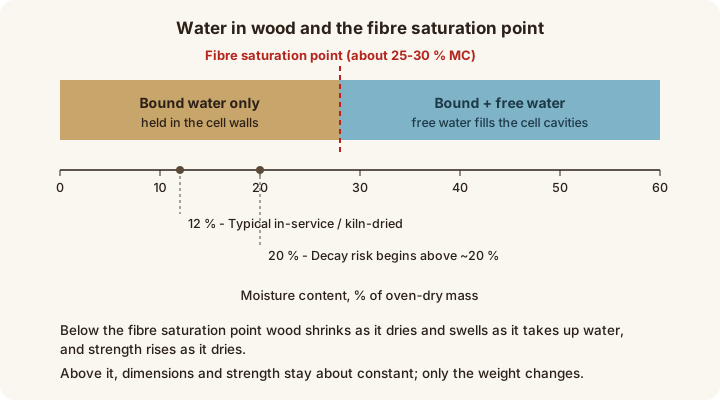
The fibre saturation point (FSP) is about 30% moisture content. Swedish Wood puts rot and blue-stain risk above FSP "around 30%"; Missouri Extension gives 25 to 30% depending on species. Above FSP the water is free and moves fast; below it, bound water moves slowly and the wood shrinks. The yard does most of its work above FSP, which is why it is cheap.
A board never dries below the equilibrium moisture content (EMC) of the surrounding air. Swedish Wood gives an example: in Malmö in November, outdoor relative humidity of about 89% corresponds to about 20% moisture content, and indoor air at about 32% RH to about 7%. The FPL Wood Handbook (1999) tabulates monthly outdoor EMC for US cities, for example Juneau, Alaska at 16.5% in January, and Phoenix, Arizona at 9.4% in January and 4.6% in June.
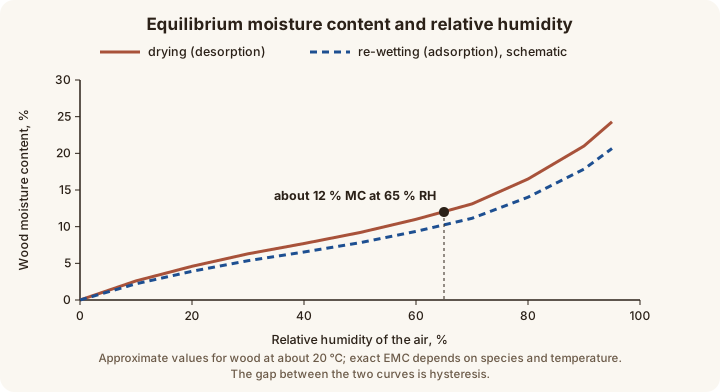
So a yard in a humid maritime climate cannot take boards much below 15 to 18% in autumn and winter. The Wood Handbook says thoroughly air-dried lumber in much of the US reaches 12 to 15% at minimum, and defines "air dry" as typically 20 to 25% for dense hardwoods and 15 to 20% for softwoods and low-density hardwoods. Interior targets are far lower (Swedish Wood: 8% for floorboards in heated rooms), so the kiln remains necessary for most products.
The other threshold is fungal. FPL-GTR-117 (Simpson, Tschernitz and Fuller, 1999) says blue stain and wood-destroying fungi cannot grow at 20% or less. A Latvian study of pine roundwood (Millers, Magaznieks and Gzibovska, 2017) says blue-stain spores do not develop at 19% or lower unless relative humidity stays above 90% for a long time. The yard must get the whole board through the band between 30% and 20% before fungi win.
Drying rates: thickness, species and season
Thickness
FPL-GTR-117 states that drying time rises roughly with thickness to the 1.5 power, so 50 mm lumber needs about three times as long as 25 mm. Our check: 2 to the power 1.5 is 2.83. McMillen and Wengert (1978) say air-dried 2-inch stock takes three to four times as long as 1-inch. Missouri Extension gives 2 to 3 months for 1-inch red oak and 6 to 8 months for 2-inch, with thicker lumber possibly taking years.
Species and place
| Species (25 mm, to 20% MC) | Days, range across US sites and seasons |
|---|---|
| Northern red oak | 70 to 200 |
| Southern red oak | 100 to 300 |
| Sugar maple | 50 to 200 |
| Yellow-poplar | 40 to 150 |
| Douglas-fir (coast) | 20 to 200 |
| Ponderosa pine | 15 to 150 |
| Sitka spruce | 40 to 150 |
Source: Simpson, Tschernitz and Fuller, Air Drying of Lumber, FPL-GTR-117, USDA, 1999 (USA).
The Wood Handbook (1999) summarises: about 15 to 30 days for low-density species in favourable conditions, and 200 to 300 days for slow species in northern locations at unfavourable times (25 mm, to 20 to 25%).
Season
Season matters as much as species. Simpson and Hart (Forest Products Journal 51(11/12), 2001) list experimental days to 20% for 4/4 lumber:
| Site and species | Winter | Spring | Summer | Autumn |
|---|---|---|---|---|
| Madison, Wisconsin, northern red oak | 115 (Jan 19) | 65 (May 15) | 72 (Jul 28) | 188 (Oct 22) |
| Upper Michigan, sugar maple | 94 (Jan 20) | 39 (May 20) | 42 (Jul 15) | 170 (Oct 28) |
| Philadelphia, American beech | 68 (Feb 8) | 33 (May 1) | 35 (Aug 1) | 112 (Nov 5) |
Source: Simpson and Hart, Forest Products Journal, 2001 (experimental values, USA).
Our reading of the Madison row: autumn stacking took 188 days against 65 for mid-May, a factor of 2.9. The paper describes a "critical stacking date" in late summer or early autumn, after which drying time rises quickly because lumber may not reach low moisture before winter, and says the rise is larger farther north. For Asheville, North Carolina, the simulation gives 76 days for red oak stacked on 1 August and 119 days for 1 October. Seattle-Tacoma Douglas-fir stacked 8 August took 18 days; stacked 17 January, 90 days. The paper also found that using only 25% of the measured wind speed changed estimates by 1 to 2 days: yard drying is governed mostly by temperature and humidity.
Oklahoma State Extension (Hiziroglu and Hitch, 2017) lists 1-inch maple, cherry and oak at 130, 150 and 200 days in an outdoor pile under a roof, against 100, 110 and 120 days in an unheated shed, 80, 90 and 100 with shed fans, and 30, 70 and 60 in a heated shed. Each step of control cuts days.
Central and Northern Europe versus North America
We did not open a European series of air-drying time tables comparable to FPL's, so this comparison rests on indirect evidence.
US data for northern sites. The Madison and Upper Michigan rows resemble a Central European or southern Scandinavian mill: good drying from May to August, a sharp deterioration from October. Stacking date is the strongest lever.
European evidence. The Scottish Wood trade article (Birley, 2026) repeats the saying that oak needs "approximately one year per inch of thickness" and that good air drying takes green hardwood from around 60% to around 20%. This is a rule of thumb, not a measurement, and it is far slower than US figures for 4/4 oak (65 to 188 days to 20%); we cannot separate the causes from the sources we opened. A Polish trial (Kowal, Dudarski and Częstochowski, 2013) dried 28 mm beech outdoors from June to October at about 20 degrees C, about 65% humidity and 2.5 to 3 m/s wind, reaching about 30% average moisture content in five months.
Temperature and fungi. Swedish Wood says blue stain can grow down to minus 3 degrees C but is colourless; visible colour appears at 8 to 10 degrees C after about a week. In the Latvian roundwood study, first blue stain appeared after 50 to 70 days at +6 degrees C average daily temperature, 30 to 42 days at +10 and 17 to 23 days at +18 (chainsaw and harvester cut, spores spread by air). These are logs, not boards, but the temperature relationship is a warning for spring in the Baltic and Nordic region. Swedish Wood names pine sapwood as most susceptible, with spruce sapwood also attacked.
Sun and cracks. In a southern Swedish test of Norway spruce exposed outdoors (Meulmann, Rydell Blom and Sjokvist, BioResources 19(2), 2024), about 65% of summer moisture gradients in an 80 mm piece were positive (surface drier than core, a cracking risk) against about 8% in winter. North-facing specimens held on average 6.7% higher moisture content than south-facing. These were small exposed specimens, not stacks, but they support the point that summer sun is the crack season while winter is the stall-and-stain season.
Yard layout and orientation
FPL-GTR-117 (1999) gives these values:
| Element | Value |
|---|---|
| Main alleys | 7 to 9 m (24 to 30 ft) wide |
| Cross alleys | 18 m (60 ft) or more, every 61 or 91 m |
| Rows | at least about 1 m (3 ft) apart |
| Line-type yard: between lines | usually 0.6 m (2 ft) |
| Line-type yard: gap between pile ends | 0.3 to 0.6 m (1 to 2 ft) |
| Row-type yard: gap between piles | about 0.6 m, up to 2.4 m in the middle of a row |
Source: FPL-GTR-117, 1999 (USA).
The same publication says north-south main alleys speed roadway drying after rain or snowmelt, and alleys should be as close to parallel with prevailing winds as possible. Oklahoma State (2017) advises stacks parallel to prevailing winds so an upwind stack does not block those behind it. Wisconsin DNR (PUB-FR-794, 2020) asks for at least 24 inches (about 0.6 m) between stacks. FPL-GTR-117 notes that low, damp yard sites encourage mould, stain and decay.
Foundations
FPL-GTR-117 says the foundation should be "reasonably high", 460 to 610 mm (18 to 24 in.). Posts are about 150 by 150 mm square or 150 to 200 mm round; cross beams are 100 by 150 mm placed on edge; forklift yards use 150 by 150 mm timbers, sometimes preservative-treated 150 by 230 mm. McMillen and Wengert (1978) recommend hand-built foundations at least 18 inches (about 460 mm) above ground and allow 12 inches (about 305 mm) for forklift yards. Wisconsin DNR says at least 12 inches. The University of Kentucky small-kiln manual (Conners, undated) says stacks must be kept off the ground because drying is slower there. FPL-GTR-117 places the cross beams on edge in line with the stickers.
Stacking rules: stickers, spacing and weight
| Source | Sticker thickness | Spacing |
|---|---|---|
| McMillen and Wengert, 1978 (USA) | 25/32 in (about 20 mm) or thicker | 16 to 24 in for many hardwoods; 12 in for valuable or warp-prone lumber |
| Wisconsin DNR, 2020 (USA) | 3/4 to 1 in (about 19 to 25 mm), 1-1/4 to 1-1/2 in wide | 12 to 18 in for thinner lumber, up to 24 in for thicker |
| Oklahoma State, 2017 (USA) | 0.25 to 1.25 in, 0.75 to 2 in wide | 16 to 24 in for 1-inch hardwoods, wider for softwoods and thicker lumber |
| Wengert, Woodworking Network, 2013 (USA) | not stated | almost always 24 in; 12 in at each end where odd lengths collect; 12 or 16 in for thinner stock or imperfect alignment |
Sources as listed; "about" conversions are ours.
Wengert (2013) says 24-inch spacing is safe only if vertical alignment is perfect, and that stickers 1 to 2 inches shorter than the pile width increase cupping and warp. Oklahoma State says stickers should be flush at the ends to reduce end checking and splitting. FPL-GTR-117 says boards are normally stacked nearly touching within a course, and stickers are a large investment worth careful making and dry storage, since dry storage keeps stain and decay fungi off green lumber. No European sticker norm was opened; all sticker figures here are US.
FPL-GTR-117 gives pile widths of about 1 to 2.4 m and heights of about 1.2 to 4.6 m, up to 9 m with bolsters. McMillen and Wengert say hand-stacked piles should not exceed 6 feet (about 1.8 m) wide without flues. Warp-restraining top weight is 60 pounds per square foot or more for air drying, with hold-down research of 50 pounds for aspen and 150 for blackgum; Wisconsin DNR asks for at least 50. Our conversion: 50, 60 and 150 pounds per square foot are about 244, 293 and 732 kg/m2. Wisconsin DNR also says to stack lumber within 2 to 3 days of sawing and leave 6 inches between roof and stack. COFORD (2004) notes that stacking sycamore boards on end for a period before piling reduces sticker stain, with no duration given.
End coating, roofs and covers
End coating. FPL-GTR-117 says to apply moisture-resistant coatings to freshly trimmed green end grain before any checking starts; cold coatings, often wax emulsions applied by swab, brush or spray, are the most widely used, and the coating must be thick. The Kentucky manual says most sawyers use a water-based wax emulsion, thin coats are insufficient, valuable thick stock should get two coats, and a gallon covers roughly 100 square feet of end grain (about 9 m2 per 3.8 litres, our conversion). FPL notes that coatings are often justified by the value they save.
Roofs. FPL-GTR-117 says roofs should project about 0.3 m (1 ft) at both ends of a level pile, with no side overhang where forklifts work. Sloped roofs drain water; materials include waterproof paper, roll roofing, plywood, hardboard and corrugated metal. Shade cloth reduces surface checking of refractory woods such as oak and beech. Pile roofs are inexpensive relative to the degrade they prevent. COFORD recommends sealing board ends and roofing oak stacks against direct sunlight. In the Polish beech trial, 12% of items showed warping, twisting or end checks deeper than 15 mm after summer drying, which the authors attributed to maximum temperatures about 30 degrees C and strong sunlight.
Sheds. A permanent roof keeps rain out, reduces end checking and splitting and keeps lumber brighter (FPL-GTR-117). See the Oklahoma figures above for the days saved.
Defects: what goes wrong in the yard
FPL-GTR-117 lists surface checks, end splits, honeycomb and warp from shrinkage; pinholes and grub holes from insects; grey surface from UV exposure, only a thin layer; blue or sap stain, mould and decay from fungi; and sticker marking plus brown or grey stain from chemical reactions.
Sticker stain. The Wood Handbook (1999) defines sticker stain as imprints darker or lighter than surrounding wood, caused by chemical or fungal action or both. COFORD flags cherry (prolonged air-drying causes discolouration under stickers), birch (prolonged air-drying can cause sticker stain) and sycamore. A WOODWEB forum thread (2010, weak evidence) reports that dry stickers are essential for maple and that one practitioner restacked after a few days with the stickers shifted slightly.
Mould and blue stain. The Wood Handbook says warm, humid periods with little air movement encourage fungal stains. Swedish Wood says mould depends on surface humidity, temperature and duration, cannot grow above 55 degrees C, and that a summer rain shower carries high risk if the wood is not dried out quickly. Blue stain does not reduce strength but makes water penetration easier. Rot needs moisture above FSP, temperature 0 to 40 degrees C, nutrients and oxygen; remove one and the risk is gone.
Checks, splits and warp. The Swedish and Polish results above tie checks to summer sun. Warp follows poor alignment, uneven spacing and too little top weight (Wengert, 2013).
Over-long storage. McMillen and Wengert (1978) say deterioration rises if air drying continues well past 18% moisture, with extra precautions if holding exceeds 2 years. They say good practice limits degrade to about 1 to 2% of lumber value, and that trimming 3 to 10 inches from board ends can mean a 6 to 20% loss on 100-inch lengths (as the source states it).
The case for pre-dryers
A pre-dryer is an enclosed, ventilated compartment that takes green lumber down to about 25% or lower before the kiln. The Wood Handbook (1999) gives typical conditions of 27 to 38 degrees C and 65 to 85% relative humidity with controlled temperature and forced circulation. The Dry Kiln Operator's Manual (Agriculture Handbook 188, revised 1991) classes predryers among low-temperature kilns operating at 70 to 120 degrees F (about 21 to 49 degrees C), some not above 110. Missouri Extension says supplemental heat usually does not exceed 120 degrees F, predryers bring lumber to 25% or less, 1-inch red oak can reach 20% in under 30 days, capacity runs from a few hundred board feet to over 1 million, and predryers reduce land and inventory costs (no numbers given).
McMillen and Wengert (1978) report test installations: a solar-assisted magnolia pre-dryer took 4/4 stock to 20% in 6 days and 8/4 in 14 days; shed-fan dryers took 1-inch elm, sap gum, hackberry and yellow-poplar from green to 29% in 6 to 7 days; controlled-air dryers took about 40% longer than forced-air dryers; accelerated air drying at 100 degrees F dried 4/4 yellow-poplar sapwood in three-fifths the time needed at 80 degrees F. They hold accelerated air drying at or below 120 degrees F, consistent with the Wood Handbook definition of air dry as forced air not above 49 degrees C.
A pre-dryer beats a yard where winter or wet seasons dominate, where stain-prone species or warm wet springs threaten, where land is scarce, and where the kiln is the bottleneck. It loses where electricity is costly, drying time does not matter, the product is sold air-dried, or land and capital are cheap. A different pre-drying route is documented in Germany: BFH researchers (Welling et al., Forschungsreport 2/1999) dried whole debarked logs in covered forest piles to 20 to 25% by the end of the following summer and reported very good wood quality (a demonstration project; construction softwood). A larch trial in Harbin, China (Hua et al., BioResources 11(3), 2016) took about 30% as its pre-dry target.
Combining air drying and kiln drying
The classic route is air dry to about 20 to 25%, then kiln. McMillen and Wengert say the customary practice is about 20% but recommend ending air drying at an average of 25% for stock going to the kiln, with surface zones at or below 20%. Kiln drying from green is more feasible where air-drying weather is poor, for instance fewer than six good months. Missouri Extension says red oak is often air dried to 25 to 30% first.
The Polish beech trial (Kowal et al., 2013, 28 mm unedged beech) is the best European evidence we opened. Air drying for five months to about 30% average moisture content was followed by kilning in 222 hours from 32%. Green beech loaded at 42% needed 279 hours. Our arithmetic: 57 hours shorter, about 20% of the green-batch cycle. The paper reports no final moisture content or energy, so no energy conclusion follows. Its authors conclude that pre-drying to about 30% does not cause significant defects if stacking and storage requirements are met, that summer is the least favourable period for open-air drying (high temperatures, strong sunlight), and that open-air drying carries uncontrollable risks. The pre-dried batch showed no quality deterioration or cracks after unloading.
Energy and cost comparison
Kiln energy. The 2026 Hungarian study (Kocsis and Németh, Drvna industrija 77(2)) measured convective drying of 28 mm oak to 10% moisture: annual specific thermal energy about 1,560 MJ/m3 and electricity about 45 kWh/m3, with summer cycles at about 1,089 MJ/m3 heat and winter at 2,312. Per kilogram of water removed, heat was about 4.3 MJ/kg in summer (initial moisture about 45%) and 6.9 MJ/kg in winter (about 55%). The authors call the results site-specific, from two cycles, and do not study pre-drying. The Dry Kiln Operator's Manual gives the heat of evaporation as approximately 1,000 Btu per pound and says 1-inch red oak dried from green to 7% loses 1.83 lb of water per board foot.
What a yard point saves (own calculation). Converting the 1978 figure of 50 to 85 Btu per board foot per point gives about 22 to 38 MJ/m3 per percentage point (1 board foot is 0.00236 m3). Removing 30 points outdoors, for example 55% to 25%, saves about 0.7 to 1.1 GJ/m3 of kiln heat. Compared with the Hungarian 1.56 GJ/m3 that is a large share, but the sources differ in decade, species and kiln, so treat it as an order of magnitude. Electricity for fans is saved less.
Money for waiting (own illustration, assumed values). Take 300 euro per cubic metre stock value, 6% per year cost of capital and 150 days in the yard, the five months of the Polish trial. Capital cost is 300 x 0.06 x 150 / 365, about 7.4 euro/m3. At an assumed heat price of 15 to 40 euro per MWh (4 to 11 euro per GJ), the kiln heat saving is about 3 to 12 euro/m3. The two are of the same order. Add handling and degrade (1 to 2% of 300 euro is 3 to 6 euro/m3, per McMillen and Wengert) and the margin is thin. Yard drying pays with expensive stock, cheap land and dear heat; with cheap softwood and cheap heat it usually does not. The gains are mostly quality, kiln capacity and risk. A Serbian comparison of beech and pine drying methods, with and without prior natural drying (Marovic and Dakovic, 2022), concludes that methods with better energy performance are not necessarily more profitable; we read only its abstract.
Inventory, land and capital tied up
Own illustration of land, with assumptions inside FPL ranges: a pile 1.2 m wide, 4.8 m long and 3 m high, half wood because of stickers and gaps, holds about 8.6 m3. With 0.6 m between pile ends and 1 m between rows, it occupies about 11.9 m2; if alleys take another 40% of the yard, about 19.8 m2 per pile. That is about 0.44 m3 of standing stock per square metre, roughly 4,000 m3 per hectare. At three turns in a good season a hectare handles roughly 12,000 m3 a year, an order of magnitude we cannot compare with a pre-dryer because we found no pre-dryer footprint data. McMillen and Wengert note that large inventories are costly, especially at high interest rates.
Controls that follow from the sources: record stacking date for each pile (the Simpson and Hart curves can then be tested against your site); set a cut-off date after which piles go to a pre-dryer or kiln instead of waiting out winter; and roof every pile, because FPL-GTR-117 warns rain penetrating a pile can cause sticker stain.
How to measure progress
Samples. The Wood Handbook (1999) says to test at least 10% of each item, for example 10 of about 60 joists chosen at random. The oven-dry method: dry at 101 to 105 degrees C until weight stops changing over 4-hour intervals, usually 12 to 48 hours for a 25 mm section; take specimens at least 500 mm from board ends, free of knots; weigh immediately after cutting. Moisture content is (weight when cut minus oven-dry weight) divided by oven-dry weight, times 100. Volatile extractives can make results slightly high.
Meters. The Wood Handbook gives reliable ranges of about 4 to 30% for dielectric and about 6 to 30% for resistance meters; readings above 30% are qualitative. Resistance meters need about 0.5% correction per 5.6 degrees C (10 degrees F) difference from calibration temperature, added when the wood is colder. Drive pins to one-fifth to one-quarter of thickness. Properly used on dried lumber below FSP, average corrected readings should be within 1% of true average. FPL-GTR-117 gives 7 to 25% as the reasonably accurate range. Frozen boards in a Nordic winter make the temperature correction non-trivial.
Swedish Wood warns that right after drying to a 16% average, surfaces are often below 10% while the centre may be above 20%, so a surface reading from a pile edge overstates dryness. Its SS-EN 14298 sampling example: for 91 to 150 planks, measure 20 and up to 3 may exceed limits; for a 16% target the batch average should be 13.5 to 18%.
Sources used
- Simpson, Tschernitz, Fuller. Air Drying of Lumber, FPL-GTR-117, 1999 (USA). https://eri.nau.edu/wp-content/uploads/2021/12/Air-Drying-of-Lumber.pdf
- Simpson, Hart. Method for estimating air-drying times of lumber, Forest Products Journal 51(11/12), 2001 (USA). https://www.woodweb.com/knowledge_base/fpl_pdfs/simps01c.pdf and https://research.fs.usda.gov/treesearch/5918
- Simpson, Hart. Estimates of air drying times for several hardwoods and softwoods, FPL-GTR-121, 2000 (USA, abstract only). https://research.fs.usda.gov/treesearch/9684
- McMillen, Wengert. Drying Eastern Hardwood Lumber, Agriculture Handbook 528, 1978 (USA). https://woodweb.com/knowledge_base_images/zp/drying_eastern_hardwood_lumber.pdf
- Simpson. Drying and Control of Moisture Content (chapter 12), Wood Handbook FPL-GTR-113, 1999 (USA). https://blog.spib.org/wp-content/uploads/2021/07/ch12.pdf
- Simpson (ed.). Dry Kiln Operator's Manual, Agriculture Handbook 188, rev. 1991 (USA, partial). https://eri.nau.edu/wp-content/uploads/2021/12/DryKilnOperatorsManual.pdf
- Wisconsin DNR. Air Drying Lumber, PUB-FR-794, 2020 (USA). https://eri.nau.edu/wp-content/uploads/2021/12/Air-Drying-Lumber_WI-DNR.pdf
- Hiziroglu, Hitch. Practicalities in Air-Drying Lumber, Oklahoma State Extension, 2017 (USA). https://extension.okstate.edu/fact-sheets/practicalities-in-air-drying-lumber
- Cutter, Stelzer. Considerations in Drying Hardwood Lumber, G5507, Missouri Extension, 1994, reviewed 2017 (USA). https://extension.missouri.edu/media/wysiwyg/Extensiondata/Pub/pdf/agguides/forestry/g05507.pdf
- Conners. Hardwood Dry Kiln Operation, FOR-128, University of Kentucky, undated (USA). https://forestry.ca.uky.edu/sites/forestry.ca.uky.edu/files/for128.pdf
- Wengert. How far apart should stickers be placed, Woodworking Network, 2013 (USA). https://www.woodworkingnetwork.com/best-practices-guide/solid-wood-machining/how-far-apart-should-stickers-be-placed-when-drying
- Knaggs, Xenopoulou. Guide to Irish Hardwoods, COFORD, 2004 (Ireland). https://www.coford.ie/media/coford/content/publications/projectreports/GuideHardwoods.pdf
- Swedish Wood. Moisture content, and Microorganisms, web pages read 2026-10-26 (Sweden). https://www.swedishwood.com/wood-facts/about-wood/wood-and-moisture/ and https://www.swedishwood.com/wood-facts/about-wood/wood-and-moisture/microorganisms/
- Kowal, Dudarski, Częstochowski. The impact of open air beech lumber storage on kiln drying, Part II, Annals of Warsaw University of Life Sciences 83, 2013 (Poland). https://agro.icm.edu.pl/agro/element/bwmeta1.element.agro-8c6cd894-a0c2-4d60-89b2-f150e2d9012b/c/66-72.pdf
- Kocsis, Németh. Energy Efficiency of Industrial Wood Drying, Drvna industrija 77(2), 2026 (Hungary). https://hrcak.srce.hr/file/502911
- Meulmann, Rydell Blom, Sjokvist. Surface Cracking and Moisture Dynamics of Untreated Norway Spruce Exposed Outdoors, BioResources 19(2), 2024 (Sweden). https://bioresources.cnr.ncsu.edu/wp-content/uploads/2024/04/BioRes_19_2_3362_Meulmann_BS_Wood_Surface_Crack_Moistur_Dynam_Spruce_Outdoor_23289.pdf
- Millers, Magaznieks, Gzibovska. Blue Stain Development of Scots Pine Roundwood, Research for Rural Development 2017 (Latvia). https://lbtufb.lbtu.lv/conference/Research-for-Rural-Development/2017/LatviaResRuralDev_23rd_2017_vol1-120-126.pdf
- Welling, Lang, Scharai-Rad, Speckels. Trocknung ganzer Stämme im Wald, Forschungsreport 2/1999, BFH (Germany). https://www.openagrar.de/servlets/MCRFileNodeServlet/timport_derivate_00016959/dk040528.pdf
- Birley. Timber seasoning and kiln drying, Scottish Wood, 2026 (Scotland, trade article). https://scottishwood.co.uk/timber-seasoning-and-kiln-drying
- Hua, Ju, Cai, Shi. Modeling the Air-drying Rate of Chinese Larch Lumber, BioResources 11(3), 2016 (China). https://bioresources.cnr.ncsu.edu/?p=3822
- Marovic, Dakovic. Analysis of Different Wood Drying Methods from Energy Usage Point of View, Zbornik FTN Novi Sad 37(9), 2022 (Serbia, abstract only). https://zbornik.ftn.uns.ac.rs/index.php/zbornik/article/view/2442
- WOODWEB. Stacking and Stickering Advice for Air-Drying Maple, 2010 (forum thread). https://woodweb.com/knowledge_base/Stacking_and_Stickering_Advice.html
Limits of this article
- No European rate tables. No Swedish, Finnish, German or Danish series of drying times for sawn boards was opened. The Europe-versus-North-America comparison rests on US seasonal data, Swedish moisture pages, one Polish trial, one Latvian roundwood study and a Scottish rule of thumb. Sticker and layout figures are US; no Nordic or EU norm was found. No Canadian source was opened.
- Partly truncated sources. The open copies of FPL-GTR-117 and the Dry Kiln Operator's Manual were cut off before the stacking, predryer and defect chapters. Values quoted from them came from extracts returned by the fetch tool, not a full read of the PDF.
- Age. The 1978 energy figures are old and are used only for an order-of-magnitude estimate. The Kentucky manual has no stated year. The Hungarian study covers two cycles at one site.
- Our calculations. The 2.83 thickness factor, unit conversions, the 20% kiln-time reduction, the 7.4 euro interest example (300 euro/m3, 6% per year, 150 days), the 15 to 40 euro/MWh heat price and the yard-area estimate are our arithmetic on stated assumptions, not data.
- Analogues. The Latvian study is pine logs and the Swedish cracking study is small spruce specimens; both are used only for temperature and sun logic.
- Weak sources. The WOODWEB thread and the Scottish Wood article are low-tier evidence.
- Not found. Pre-dryer capital and operating costs, a pre-dryer footprint, and species-specific sticker-stain chemistry were not available from sources we could read. Nothing here replaces trials in your own yard.
Jak sprawdzono ten tekst · sprawdzono 2026-10-26
Sources opened one page at a time via WebFetch; figures taken from extracts returned for each page; own calculations labelled in text.
Nie udało się zweryfikować
- FPL-GTR-117 and Dry Kiln Operator's Manual PDFs truncated: stacking, predryer and defect chapters not read directly
- No European sawn-timber air-drying rate tables opened
- Kentucky manual has no stated year
- Marovic and Dakovic 2022 abstract only
- Scottish Wood 'one year per inch' is a trade rule of thumb
Źródła
- Air Drying of Lumber, FPL-GTR-117 (1999)
- Simpson and Hart, Method for estimating air-drying times of lumber (2001)
- Simpson and Hart, Method for estimating air-drying times (treesearch record)
- Simpson and Hart, Estimates of air drying times, FPL-GTR-121 (2000, abstract)
- McMillen and Wengert, Drying Eastern Hardwood Lumber, Agriculture Handbook 528 (1978)
- Wood Handbook FPL-GTR-113 chapter 12, Drying and Control of Moisture Content (1999)
- Dry Kiln Operator's Manual, Agriculture Handbook 188 (rev. 1991)
- Wisconsin DNR, Air Drying Lumber PUB-FR-794 (2020)
- Oklahoma State Extension, Practicalities in Air-Drying Lumber (2017)
- Missouri Extension G5507, Considerations in Drying Hardwood Lumber (1994, reviewed 2017)
- University of Kentucky FOR-128, Hardwood Dry Kiln Operation
- Wengert, How far apart should stickers be placed (2013)
- COFORD, Guide to Irish Hardwoods (2004)
- Swedish Wood, Moisture content
- Swedish Wood, Microorganisms
- Kowal et al., Impact of open air beech lumber storage on kiln drying, Part II (2013, Poland)
- Kocsis and Nemeth, Energy Efficiency of Industrial Wood Drying, Drvna industrija (2026, Hungary)
- Meulmann et al., Surface Cracking and Moisture Dynamics of Norway Spruce Outdoors, BioResources (2024, Sweden)
- Millers et al., Blue Stain Development of Scots Pine Roundwood (2017, Latvia)
- Welling et al., Trocknung ganzer Stamme im Wald, BFH Forschungsreport (1999, Germany)
- Scottish Wood, Timber seasoning and kiln drying (2026)
- Hua et al., Modeling the Air-drying Rate of Chinese Larch Lumber (2016)
- Marovic and Dakovic, Analysis of Different Wood Drying Methods from Energy Usage Point of View (2022, abstract)
- WOODWEB, Stacking and Stickering Advice for Air-Drying Maple (2010, forum)
Znajdź firmy oferujące tę usługę
Ostatnia aktualizacja: 2026-10-26