Nauka o drewnie
Wood Cell Wall: Cellulose, Hemicellulose and Lignin
Cellulose, hemicelluloses, lignin and extractives, the S1/S2/S3 wall layers, typical softwood and hardwood composition ranges, and how microfibril angle controls stiffness, shrinkage and drying behaviour, with sourced numbers and stated uncertainties.
Kraj / region badania lub danych: Mixed: US data (USDA Wood Handbook, Rowell and others chapter on US woods); New Zealand (radiata pine lignin and MFA studies, Donaldson); European data limited to a University of Gottingen lecture note (Germany) and a Slovak teaching presentation giving Central European species (spruce, pine, beech, oak).
Why this matters in the sawmill
Sawmill problems that look like bad luck, such as a board that moves along its length, a stack that collapses or checks in the kiln, or a log that saws stiff when another of the same species does not, are often cell-wall problems. Wood is a composite of a few polymers arranged in layers, and the way they are packed sets how stiff a board is, how much it shrinks and in which direction, how fast it gives up water, and how it reacts to heat.
This article explains that chemistry and ultrastructure in terms a mill manager can use: what cellulose, hemicelluloses, lignin and extractives are, how the wall layers are arranged, why microfibril angle matters, and what typical composition ranges are for softwoods and hardwoods. Numbers come from the USDA Forest Products Laboratory Wood Handbook, a Forest Service chapter on cell wall chemistry and the papers listed under sources. Where a source gives no number, I do not supply one. Data are mostly North American (US Wood Handbook, US woods in the Rowell chapter, radiata pine from New Zealand); the European material is a University of Gottingen lecture note and a Slovak teaching presentation giving Central European species values.
The four building blocks
Dry wood is mostly three polymers plus a small fraction of minor substances. The Wood Handbook (1999 edition) puts cellulose at about 50% of wood substance by weight, with lignin and hemicelluloses making up most of the rest and extraneous materials a minor part.
Cellulose is a linear chain of D-glucose units joined by beta-1,4 bonds. In native wood a chain has roughly 10,000 to 15,000 units (University of Gottingen course material). Chains pack side by side, held by hydrogen bonds, into thread-like microfibrils, and the cellulose in the wall is commonly described as largely crystalline (a standard statement that I could not re-confirm in the Wood Handbook pages reopened for this check). Cellulose is the stiff reinforcing element of the wall.
Hemicelluloses are much shorter, branched polysaccharides built from several sugars; the Gottingen material gives an average degree of polymerisation of only 120 to 200. Softwood hemicellulose is mainly glucomannan with some xylan, whereas hardwood hemicellulose is mainly xylan carrying glucuronic acid and acetyl groups. The same source lists the amounts of different sugars in wood, as shares that add up to about 100%; they therefore appear to be shares of all wood sugars and not of the hemicellulose fraction alone (glucose includes cellulose glucose), although the page does not say so explicitly. For softwood the values are glucose 64.5%, mannose 12.0%, xylose 10.3%, galactose 9.3% and arabinose 3.3%, and for hardwood glucose 65.2%, xylose 28.3%, mannose 2.6%, galactose 2.3% and arabinose 1.5%.
Lignin is a three-dimensional phenolic polymer that fills the spaces around the cellulose and hemicelluloses. The Wood Handbook (2010 edition) calls it a brittle, hydrophobic matrix material and says the middle lamella is lignified.
Extractives are the non-structural organic substances, such as resins and phenolics, that can be dissolved out with solvents, plus a small mineral fraction. The Wood Handbook gives extractives as roughly 5% to 30% of wood substance depending on species and growth conditions and inorganic material as 0.2% to 1.0%; the upper end presumably applies to extractive-rich species, since the composition figures below are much lower (portal interpretation; the central European table below gives extractives of 1% to 5.6%). Heartwood extractives plug passageways and slow drying relative to sapwood (Wood Handbook drying chapter).
Typical composition: softwoods versus hardwoods
Composition varies with species, position in the tree and analytical method, so ranges are the honest way to report it.
| Component | Softwood | Hardwood | Source |
|---|---|---|---|
| Cellulose | 40-45% | 38-49% | Rowell, Pettersen and Tshabalala, 2013 |
| Lignin | 26-34% | 23-30% | Rowell and others, 2013 |
| Pentosans (xylan-type sugars) | 7-14% | 19-26% | Rowell and others, 2013 |
| Lignin | 23-33% of wood substance | 16-25% of wood substance | Wood Handbook, 1999 edition (US) |
| Lignin | about 25-35% | about 20-30% | University of Gottingen lecture note (Schopper, 2008; read from a chart, so approximate) |
| Lignin | spruce 26.9%, pine 26.6% | beech 20.9%, oak 22.6% | Tino, 2021, Central European species (teaching presentation) |
| Alpha-cellulose | spruce 45.6%, pine 43.2% | beech 39.2%, oak 46.3% | Tino, 2021, Central European species |
| Hemicelluloses | spruce 27.6%, pine 28.0% | beech 35.3%, oak 36.7% | Tino, 2021, Central European species |
The Rowell and others ranges are given in the chapter abstract for U.S. hardwoods and softwoods; the species data behind them are in the chapter's Table 3.1 (Pettersen, 1984), which I could not open. The Central European rows come from a teaching presentation that cites no primary source, and its own text says hemicellulose is higher in conifers than in broadleaves while its table shows the opposite, so I rely on its table only as an indicative example. The robust messages are these. Cellulose is roughly 38-50% in both groups. Softwoods are higher in lignin, around a quarter to a third of the substance. Hardwoods carry much more xylan-type hemicellulose (pentosans 19-26% against 7-14%), while softwoods carry more mannose-rich glucomannan. All lignin sources agree that softwoods carry more lignin than hardwoods; the ranges differ because they cover different species sets and, probably, different analytical methods (not checked). The Central European softwood values fit inside every softwood range quoted, and the hardwood values fit the Wood Handbook and Gottingen ranges but are slightly below the Rowell range of 23-30%. Rowell and others also note that simple chemical analysis can separate hardwoods from softwoods but cannot reliably identify individual species. Their abstract adds that carbohydrates are 65-75% of the dry cell wall and lignin 18-35%.
The layered wall
A wood cell is a hollow tube whose wall is laid down in layers. The Wood Handbook names them: the middle lamella, the primary wall and the secondary wall, divided into S1, S2 and S3 layers around the central cavity, the lumen.
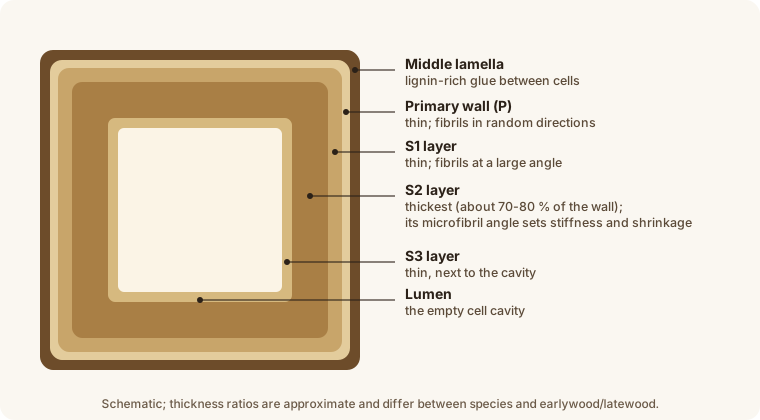
Layers of a wood cell wall, from the glue between cells (middle lamella) through the primary wall to the S1, S2 and S3 layers of the secondary wall around the lumen. S2 is the thickest layer and dominates wall properties.
The middle lamella bonds neighbouring cells and is very rich in lignin. Donaldson (1985), working on Pinus radiata tracheids, found about 81% lignin by volume in the cell-corner middle lamella (overall range 72-92%) against about 21% by volume in the S2 region (range 19-23%), so the corner is roughly four times as lignified (on a weight basis the paper gives about 71% and 18%). The data come from five 50-year-old trees from one New Zealand forest, measured by interference microscopy. In one mild compression-wood specimen the values were 89% and 24%. Because S2 is far thicker than the middle lamella, this does not mean most lignin sits in the middle lamella; the sources I opened give no layer volume fractions.
The primary wall is thin. The secondary wall carries the load, and S2 is its thickest layer and the main contributor to wall properties. Microfibril angles, measured from the long axis of the cell, are 50 to 70 degrees in S1, 5 to 30 degrees in S2 and more than 70 degrees in S3 (Wood Handbook). S1 and S3 therefore wrap around the cell like hoops, while S2 microfibrils run nearly parallel to its axis. S3 has the lowest lignin of the secondary layers. Chemistry also changes across the wall: the Gottingen material tabulates spruce cellulose rising from about 33% in the middle lamella and primary wall through about 55% in S1 to about 64% in S2, and glucomannan from about 8% to about 24%; the species and the study behind the table are not identified. In tension wood of hardwoods a gelatinous (G) layer replaces part of the normal wall (Wood Handbook).
Microfibril angle: the control knob for stiffness and shrinkage
The S2 microfibril angle (MFA) is the most informative single wall parameter. Donaldson's review states that the average S2 MFA of mature conifer wood lies between 5 and 20 degrees, with the highest angles in juvenile wood (there the inner 10 to 15 rings), especially the first five rings at the base of the tree. Hardwoods are generally below 20 degrees: 19 degrees at the pith falling to 12 at the bark in Betula pendula at 1 m, although 11-year-old Populus clones ran from 28 at the pith to 8 at the bark, an exception to the rule. Within a ring, the review cites about 20 degrees in latewood against under 5 in earlywood for Norway spruce, from older measurements on one species; the superscripts in the copy I read are garbled, so treat these values as indicative.
Stiffness. Low angles put the stiff cellulose along the cell axis. The relation between MFA and longitudinal stiffness is curvilinear and has been repeatedly demonstrated, but the review cites a greater MFA effect in juvenile wood and the butt log. That density is the main driver in mature wood is the portal's inference, not a statement of the review, which notes only that density varies mainly in mature wood. Single-fibre tests cited there show tensile strength falling from 220 MPa at 5 degrees to 35 MPa at 50 degrees. In 104 Eucalyptus delegatensis specimens, density and MFA together explained 96% of the variation in stiffness, but in some radiata pine clones MFA contributed little compared with spiral grain and knot area. MFA is therefore one driver among several, strongest in corewood.
Shrinkage. Shrinkage is a cell-wall effect that begins below the fibre saturation point, which averages about 30% moisture content with several points of variation between species and pieces (Wood Handbook). Longitudinal shrinkage is normally only 0.1% to 0.2%, but juvenile and reaction wood can reach about 2%. Donaldson's review links this to angle: longitudinal shrinkage increases with MFA, very high angles giving more longitudinal shrinkage and very low ones comparatively more tangential shrinkage, with no numeric thresholds given. In a loblolly pine study MFA explained only 60-70% of the longitudinal variation, so it is strong but not exclusive. Tangential shrinkage is about twice radial; as percent of green dimension (radial, tangential, volumetric) the Wood Handbook lists eastern white pine 2.1, 6.1, 8.2; Sitka spruce 4.3, 7.5, 11.5; white oak 5.6, 10.5, 16.3; old-growth redwood 2.6, 4.4, 6.8.
Reaction wood and warp. Compression-wood tracheids have a large S2 angle, high lignin and high longitudinal shrinkage (Wood Handbook). Donaldson reports mild compression wood averaging about 5 degrees above normal wood and severe compression wood about 8 degrees above, with up to 17 degrees difference in radiata pine. The drying chapter lists irregular grain and juvenile or reaction wood as aggravating warp, consistent with unequal longitudinal shrinkage inside one board.
Chemistry, water and drying
Below the fibre saturation point the wall holds bound water; above it, free water sits in the lumen. Maximum possible moisture content is 267% at a basic specific gravity of 0.30 and 44% at 0.90 (Wood Handbook). Equilibrium moisture content at 21.1 degrees C (Wood Handbook 2010, US data; the table was derived primarily for Sitka spruce but is said to apply to wood of any species for most practical purposes) is about 1.3% at 5% relative humidity, 9.2% at 50% and 23.9% at 95%, and adsorption values average about 0.8 times desorption values near room temperature, which is why wood dried from green and wood re-wetted settle at different moisture contents under the same air.
Three links to kiln practice follow from the sources. Lignin is hydrophobic (Wood Handbook); the common view that hemicelluloses are the most water-accessible component was not confirmed in the sources I opened, which give no direct sorption data by composition, so any softwood-versus-hardwood sorption difference should be treated as an inference. Heartwood extractives plug passageways and slow drying relative to sapwood, while diffusion along the grain is 10 to 15 times faster than across, so flatsawn lumber dries faster than quartersawn. And temperature limits depend on strength: stronger wood at lower moisture content tolerates higher temperature and lower relative humidity, whereas collapse and honeycomb arise when temperature is too high, for too long, in wet wood. Brown stain in pines and darkening in hardwoods occur if drying temperatures are too high; the source gives no reaction chemistry or thresholds.
Practical rules of thumb for sawmills
- Expect corewood to be less stiff and less stable: high MFA, low density and high longitudinal shrinkage coincide in the first rings.
- Do not rely on density alone to predict stiffness in juvenile or butt-log material, where MFA has a greater effect; in mature wood density is probably the more useful single predictor (portal inference).
- Treat longitudinal shrinkage well above 0.1% to 0.2% as a flag for juvenile or reaction wood and a warp risk when sorting.
- Use about 30% moisture content as the fibre saturation point when species data are missing, as the Wood Handbook advises, and expect a few points of error.
- Keep schedules gentle while the wood is wet; high temperature early is the source of collapse and honeycomb.
- Plan for heartwood, especially of extractive-rich species, to dry more slowly than sapwood.
- Do not try to identify species from bulk chemistry; it separates softwoods from hardwoods, not species.
What is uncertain or varies
- Composition figures vary with species, tree position, laboratory definitions and whether hemicellulose or pentosan is reported; the ranges above are indicative.
- The Wood Handbook lignin and extractive figures come from the 1999 edition (the 2010 text I reopened has no composition section) and differ somewhat from Rowell and others (2013), the Gottingen note and the Central European example; the differences are attributed above to species sets and methods, not resolved. The extractive range of 5-30% is as printed and seems to refer to extractive-rich species.
- I found no layer thicknesses or volume fractions (for example the share of S2 in wall thickness) in the sources I opened, so none are given.
- MFA values come from particular species and sites. The 5-20 degree mature-conifer range is a review summary, and the Wood Handbook gives a wider 5-30 degree range for S2.
- Statements about heat damage to hemicelluloses or extractives at kiln temperatures are not backed by figures in my sources, so no thresholds are claimed.
- I could not open the Wood Handbook directly on the Forest Service site, so chapters were read from course reproductions: the structure and moisture chapters are the 2010 edition (FPL-GTR-190), the composition statements are the 1999 edition (FPL-GTR-113) and the drying chapter is from the 2021 edition (FPL-GTR-282). The 2021 versions of the structure and moisture chapters were not opened.
- The Rowell chapter was read through its abstract only; the full chapter and its Table 3.1 were not available.
Key points
- Wood is a composite: cellulose microfibrils (roughly 38-50%) embedded in hemicelluloses and lignin, with a few percent extractives and ash.
- Softwoods are richer in lignin (26-34% in one source) and glucomannan; hardwoods carry far more xylan (pentosans 19-26% versus 7-14%).
- The wall has a middle lamella, a primary wall and S1, S2 and S3 secondary layers; S2 is thickest, with microfibrils at 5 to 30 degrees.
- Lignin is most concentrated in the middle lamella (about 81% by volume at cell corners in radiata pine against about 21% in S2).
- A large S2 microfibril angle means lower stiffness and higher longitudinal shrinkage, most marked in juvenile and reaction wood.
- Fibre saturation averages about 30%; tangential shrinkage is about twice radial, and longitudinal shrinkage is normally 0.1% to 0.2%.
Jak sprawdzono ten tekst · sprawdzono 2026-10-26
Re-opened Wood Handbook chapters (1999 and 2010 reproductions, 2021 drying chapter), Rowell and others (Treesearch abstract page), Donaldson's MFA review and 1985 lignin paper, and the Gottingen pages; searched for European composition data and found a Central European species table and a Gottingen lignin note.
Poprawki wprowadzone podczas sprawdzania
- Sugar composition percentages are shares of total wood sugars (sum about 100%), not of the hemicellulose fraction as the text stated.
- Spruce cellulose 33% is for the middle lamella/primary wall (not 'outer layers'); S1 55% and S2 64% added; species and study unidentified.
- Wood Handbook lignin 'concentrated in the middle lamella, cementing agent' replaced with what the 2010 text actually says (brittle hydrophobic matrix; middle lamella lignified).
- Lignin range discrepancy now explained (different species sets and methods) instead of 'could not reconcile'; European data (Gottingen, Central European species) added and labelled.
- Donaldson 1985: values are by volume (weight basis 71%/18%), from five 50-year-old radiata trees in one NZ forest; compression-wood values from one mild specimen.
- Hardwood MFA 'generally below 20 degrees' qualified: Populus pith value 28 degrees is an exception.
- 'In mature wood density dominates' relabelled as portal inference; Donaldson only cites a greater MFA effect in juvenile wood and butt logs.
- 'Hemicelluloses are more water-accessible' relabelled as unconfirmed; 'slow drying across the grain' removed (source says extractives plug passageways).
- 'Cellulose largely crystalline' hedged (not re-confirmed); extractives 5-30% interpretation labelled; EMC table basis (Sitka spruce, any species) added.
- Edition statement made explicit (1999, 2010, 2021).
Nie udało się zweryfikować
- Full Rowell chapter and Table 3.1 (Pettersen 1984) not opened; ranges taken from the abstract.
- Tino (2021) is a teaching slide set citing no primary source; its text and table disagree on hemicellulose.
- Gottingen lignin ranges are read from a chart description and are approximate.
- Cellulose crystallinity, hemicellulose water accessibility and typical hemicellulose types are standard textbook statements not re-confirmed in opened sources.
- 2021 Wood Handbook chapters 3-4 not opened.
- Statements on kiln temperature limits, collapse and honeycomb come from the 2021 drying chapter as summarised earlier; only partly re-checked.
Źródła
- Wood Handbook chapter 'Structure and Function of Wood' (reproduction, CED Engineering)
- Wood Handbook FPL-GTR-113 (1999), Chapters 2 and 3 (reproduction, CED Engineering)
- Wood Handbook chapter 'Moisture Relations and Physical Properties of Wood' (reproduction, CED Engineering)
- Wood Handbook drying chapter, 'A Guide to Wood Drying, Moisture Content and Dimensional Changes' (reproduction, CED Engineering)
- Donaldson, L. 'Review - Microfibril angle: measurement, variation and relationships' (Scion)
- Donaldson, L.A. 'Within- and between-tree variation in lignin concentration in the tracheid cell wall of Pinus radiata' (NZ J. For. Sci. 1985)
- Schopper, C. 'Cellulose - Hemicellulose' (University of Goettingen, biotechnology of trees and fungi)
- Rowell, Pettersen and Tshabalala 'Cell Wall Chemistry' (USDA Forest Service Treesearch, 2013)
- Schopper, C. 'Lignin' (University of Goettingen, biotechnology of trees and fungi, 2008)
- Tino, R. 'Selected wood chemical properties - bridge to technology' (Slovak University of Technology presentation, 2021; Central European species)
Ostatnia aktualizacja: 2026-10-26