Nauka o drewnie
Natural Wood Defects: Knots, Reaction Wood and Grain
How knots, compression and tension wood, spiral grain, pith, shake, wane, rot and stain form, how they show in logs and boards, and how they affect strength, drying and grade. Sourced figures from Europe, North America and Australia, with honest caveats.
Kraj / region badania lub danych: Europe (Hungary, Sweden, Great Britain, Germany/Finland studies); North America (Penn State Extension, USDA Wood Handbook ch. 4); Australia (Grant et al. radiata pine, Wood Review).
Why this matters in the sawmill
Most of the value lost between the log yard and the packing line is lost to a short list of natural features. Knots decide structural and appearance grade. Reaction wood decides whether a board stays straight in the kiln. Spiral grain decides whether a stud twists. Shake, wane, rot and stain decide whether part of a log yields usable boards at all. None of these are processing faults: they are built into the tree, and the sawmill can only recognise them early, route each log to the right product, and avoid making them worse.
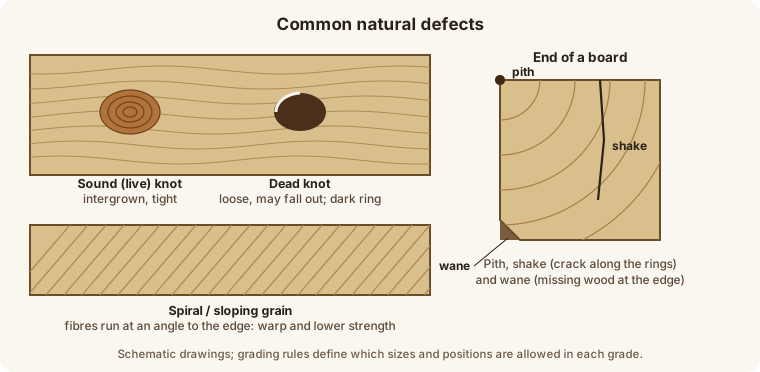
Figure: the main natural defects discussed here, as they appear in a log and in the boards cut from it. Schematic only; real features vary widely in size and severity.
This article explains how each defect forms, how it looks on a log end and on a sawn face, what it does to strength, drying and appearance, and how sawyers and scanners deal with it. Every number is tagged with its source and region. During re-verification I could read the chapter 4 (moisture relations) reproduction of the US Wood Handbook (FPL-GTR-190, 2010 edition) and a partial chapter 5; the Handbook sections on knots, slope of grain and reaction-wood strength were not in the parts I could read. Handbook chapter 4 is used only for the longitudinal shrinkage figures of reaction wood.
Knots: types, size and position
A knot is the embedded base of a branch. In a sawn board it appears as a section through that branch, and its shape depends on how the saw cut meets the branch axis.
Sound (live, intergrown) knots come from branches that were alive while the stem grew around them. Stem and branch fibres are joined, so the knot is firmly held. Dead (loose, encased) knots come from branches that died while the tree kept growing. The stem wood grows around the dead stub rather than joining it, often with bark or resin between, so the knot can loosen and drop out as the board dries. In general forestry knowledge (not checked in the cited pages), dead knots concentrate in the outer part of the log, where lower branches died early, while sound knots dominate nearer the pith. The depth of the dead-knot zone depends on species, stand density and pruning history.
Graders also classify knots by position in the piece. Grant, Anton and Lind (1984), studying structural Pinus radiata from New South Wales, Australia (published in the New Zealand Journal of Forestry Science), separated face knots, margin knots (on the edge of the wide face), margin-and-face knots, and arris knots (at the corner). This matters because the same knot does very different damage depending on where it sits.
Size is usually expressed as a ratio, such as the knot area ratio (KAR), the share of the cross-section taken by knots. In the Australian radiata study the group mean KAR ranged from 0.11 (arris knots) to 0.48 (margin-and-face knots in 35 x 70 mm timber), and bending strength decreased as KAR increased.
Effect on strength. A knot removes load-carrying clear wood and also deflects the grain around itself, creating local slope of grain and stress concentration. The damage depends strongly on position. A finite-element study of Norway spruce beams by Saad and Lengyel (2023, Hungary, Europe) found that a knot at mid-span cut load-bearing capacity by about 39 percent, and in a separate comparison of vertical positions the largest loss, about 69 percent, occurred with the knot at the lowermost (tension-side) position. Knots in the compression zone had only a marginal effect. One physical test beam (100 x 100 mm section, 900 mm span) with a 35 mm knot lost about 28 percent by the authors' figure, which could not be reproduced exactly from their table. These are model results for particular beam geometries, useful as a ranking of mechanisms rather than as design values.
Knots reduce stiffness (modulus of elasticity, MOE) too, usually less than strength. In Grant et al. (1984), MOE fell as density decreased and as KAR increased, and measured MOE was the main predictor of bending strength; once MOE was known, density added nothing. That is the logic of machine grading: stiffness integrates knots, density and grain.
Grades are sensitive to small shifts. In the same dataset the authors expected a 10 percent fall in average density to lower the average grade of 35 x 90 mm timber with face knots by one stress grade (they write F5, which is inconsistent with an F8 starting grade, so the exact grades are uncertain), and estimated a 7 to 10 percent decrease in the value of mechanically graded timber. They found that the visual rules of the time would grade margin and margin-and-face knots two grades too high and face knots one grade too high; that finding is about 40 years old and Australian, so it does not describe current European rules.
Effect on sawing and drying. Knots are denser and harder than surrounding wood and often resinous, so they dull knives and can tear grain when planing. Dead knots can fall out, and checks commonly start at knots in drying.
Reaction wood: compression and tension wood
Trees that lean, or whose crowns are pushed by wind or slope, build special wood to straighten the stem. Softwoods form compression wood on the underside of the lean; hardwoods form tension wood on the side opposite the lean (Penn State Extension, North America). Both shrink abnormally along the grain.
On the log. The clearest sign on a log end is eccentric growth: an off-centre pith with wider rings on one side, the reaction wood on the wider side (Penn State Extension; Wood Review, Australia). Wood Review says severe compression and tension wood show zones of increased density and hardness, usually appearing darker, and that tension wood sometimes appears silvery and other times dull and lifeless. Mild zones are hard to see even on a fresh surface (our reading of the source), although it notes that wetting can make markings more distinct on smaller cross-sections. On the log deck, lean, sweep and crook are warning signs.
Compression wood is described anatomically as having rounded tracheids with gaps between them (general anatomy, not found in the cited pages). According to the Australian source its fibres can be up to about 30 percent shorter, and it has lower stiffness in spite of increased density. It has a higher lignin content, and its across-grain shrinkage tends to be lower than that of normal wood, while its longitudinal shrinkage is much higher.
Tension wood is described as having fibres with a gelatinous wall layer (general anatomy, not checked in the cited pages). Penn State Extension says that in sawing its fibres are partially torn out rather than cut clean, that it can give an uneven appearance when stained, and that it has a higher tendency to collapse in drying; that planing may not remove the fuzzy surface is our extrapolation. In severe tension wood the collapse may not recover on reconditioning (Wood Review).
How large is the longitudinal shrinkage? Sources differ. Penn State Extension states that it could be as much as six times normal for compression wood and three to five times for tension wood (North America). The Australian Wood Review page says up to 20 times for both types, green to oven-dry. The US Wood Handbook (chapter 4, read in a reproduction) gives average longitudinal shrinkage of 0.1 to 0.2 percent for most species and says reaction wood and juvenile wood can shrink about 2 percent from green to oven-dry; by our arithmetic that is about 10 to 20 times normal, which agrees with the Australian upper figure. Wengert and Meyer (University of Wisconsin) give under 0.1 percent for normal mature wood from green to kiln-dry. The lower Penn State multiples probably describe less severe wood or other conditions, but no source says so, and the true multiple varies with species and severity.
Consequences in lumber. Uneven longitudinal shrinkage across a piece produces bow, crook and sometimes twist, and distortion can continue after drying as locked-in stresses release (Wood Review). Johansson (2003, Wood and Fiber Science) measured distorted geometry along 12 timber studs, then cut them into 3,600 sticks of 10 x 10 x 200 mm and measured longitudinal shrinkage for a change from 18 to 8 percent moisture content. Sticks classified as containing severe compression wood had significantly higher longitudinal shrinkage than sticks with none or mild compression wood, and mild compression wood also shrank more than none. His model suggests that variation in longitudinal shrinkage across the section and along the stud explains most of the change in bow and crook, and it predicted bow better than crook. The abstract does not state the species or country (the reference list points to Norway spruce and Swedish institutions, which is an inference), so treat it as a demonstration of the mechanism, not a regional dataset.
Grain deviations: spiral and cross grain
Cross grain means fibres that are not parallel to the board axis. It is either diagonal, caused by sawing a tapered or crooked log parallel to the bark rather than to the pith (a sawing issue), or spiral, where fibres wind around the stem (a growth feature).
Spiral grain matters mainly because it causes twist on drying. In Norway spruce the angle at breast height is usually small: in Swedish progeny trials (28 or 29 years old, measured near breast height) Hallingbäck, Jansson and Hannrup (2008, Europe) found a mean grain angle under bark of 1.76 degrees, but about 7 percent of progeny trees had 4 degrees or more; the authors speculate that such old trees could be left-grained, and I add that large angles of either hand favour twist. Broad-sense heritability in the three progeny trials was 0.44 to 0.63 (narrow-sense 0.32 to 0.44), so the authors regard selection of seed sources as a way to reduce the problem over generations. The paper reports that left-handed grain angles increase over the first annual rings from the pith, peak around the tenth ring at about 3 degrees and then decline, so the claim in an earlier version of this article that spiral grain is strongest right at the pith is not supported for Norway spruce; core boards may still twist more, but I have not verified that.
Effect on strength. Off-axis fibres are generally expected to cut strength more than stiffness (a general statement not tested in the pages above), and slope of grain is hard to judge by eye on a rough face, which favours stiffness-based machine grading. I could not retrieve the Wood Handbook table of strength versus slope; the Canadian Wood Council lecture cited in our mechanical-properties article gives 93, 81 and 55 percent of straight-grain strength at slopes of 1 in 20, 1 in 10 and 1 in 5 (property unnamed there), but I have not verified these against the Handbook, so treat them as indicative.
Pith, shake, wane, resin pockets, rot and stain
Pith. The pith is the soft central core, surrounded by juvenile wood. Boards containing it ("boxed heart") are generally described as having tight, high-angle rings, higher longitudinal shrinkage (Conners, University of Kentucky, defines juvenile wood as the first 10 to 15 growth rings, which shrink more than mature wood) and a tendency to crack radially in drying; the cracking and the claim about specifications are general trade knowledge not checked in these sources. Many specifications limit or exclude pith for this reason.
Shake. Shake is a separation along the grain. Ring shake follows the growth rings, and on a log end looks like a partial or complete circle; star shake runs radially from the pith. Shake sometimes shows only after sawing or drying. For oak in Great Britain, Price (2015, Europe) reviewed the evidence on shake (internal longitudinal splitting in the growing tree, as ring or star shake; star shake is the more frequent). Ring shake is correlated with a sudden change in growth rate; tentative data link it to sandier soils; low calcium (poor soil richness) and severe cold (frost cracks accompanied shakes) are also reported; the report says the roles of wind and of steep ground have not been verified or proven. Ring shake was reported anecdotally as uncommon below 45 cm diameter, and affected trees were almost twice as common on shallow soil (under 50 cm), a finding reported for shake in general. About 21 percent of British high forest oak trees were estimated to be affected by shake (Mather and Savill, 1994, as cited by Price), while one highly shake-prone site had 73 percent of trees affected and a likely financial loss of about 21 percent on the overall sale parcel. These are British oak figures and must not be transferred to conifers; I found no open source with comparable softwood numbers. That shake lowers shear resistance and splits boards apart is our reasoning from its definition (the report makes no such claim), and shaken logs are in practice downgraded or sorted into low-value products.
Wane. Wane is missing wood at an edge or corner where the log's rounded surface or bark remains. It appears when the log is small, tapered or crooked relative to the sawing pattern; optimisers reduce it through offset and skew.
Resin pockets, rot and stain. Resin pockets are cavities holding resin, found mainly in softwoods such as spruce, pine, larch and Douglas fir; they matter for painted and visible surfaces (general trade knowledge, not sourced here). Decay that begins in the standing tree or stored log cannot be reversed and is cut out. Sapstain (blue stain) develops in the sapwood of felled logs, notably pine, when moisture and temperature allow, and mainly affects appearance. Stain is managed by speed: short storage, cool or wet storage, prompt sawing and drying. This paragraph is general trade knowledge; I had no open source with figures.
How sawyers and scanners handle defects
At the yard, logs are sorted by diameter, length and visible quality. The log end is the main information point: eccentricity, rot, shake, resin and pith position are visible there.
In the sawmill, a laser or optical scanner measures the outer shape and the optimiser selects position (offset, skew, rotation) and pattern to maximise value. Because it sees only the surface, it must infer the interior. X-ray and computed tomography (CT) systems find internal knots. Stängle and co-authors (2015, Annals of Forest Science, Germany/Finland, European beech) measured 670 knots in CT images of 33 beech logs, virtually sawed them in the InnoSIM software at 12 rotation angles, and found that the optimal rotation raised total volume and total product value by up to 24 percent compared with the average over all simulated angles. This is a simulation on one species; real gains depend on product mix and on whether logs can be rotated reliably.
After sawing, boards are inspected visually or by machine, then cut by an optimising cross-cut saw that removes the worst defects. Strength graders use stiffness and often density or X-ray to estimate strength.
Practical rules of thumb for sawmills
These are working rules drawn from the mechanisms above, not published thresholds. Check them against your own product specifications.
- Read the log end first. An eccentric pith with wide rings on one side signals reaction wood; steer such logs away from long, thin, straight products.
- Segregate suspected reaction wood and boxed-heart pieces for the kiln, or dry them with restraint, because they distort differently from normal boards.
- Judge knot position as seriously as size: an edge or tension-side knot in a structural piece is worse than a larger knot at the neutral axis or on the compression side.
- Expect dead knots to loosen in the kiln; for appearance products, grade after drying.
- Do not trust the eye on spiral grain; run twist trials on sample boards from each supplier region (our suggestion; Hallingbäck et al. found heritable differences between progenies).
- Where sapstain matters, minimise log storage time and keep logs cool or wet.
What is uncertain or varies
- The longitudinal shrinkage multiple of reaction wood differs between sources (up to 6 and 3 to 5 times in North American extension material, up to 20 times in an Australian trade page, about 10 to 20 times by our reading of the Wood Handbook's 2 percent against 0.1-0.2 percent); the conflict is not resolved.
- Knot effects depend on beam geometry, species, grading rule and moisture; the quoted values are model results or from one Australian dataset.
- Shake numbers are for British oak and several of the associations (wind, steep ground, soil) are tentative in the source; ring shake in conifers is real but not quantified here.
- Wood Handbook strength ratios for slope of grain and knots were not accessible, so none are quoted.
- CT gains come from a simulation on one hardwood species.
Key points
- Knots, reaction wood, spiral grain, pith, shake, wane, rot and stain cause most natural grade loss.
- Knot damage depends on position as well as size; a mid-span tension-zone knot cut modelled bending capacity by about 39 percent in Norway spruce (Europe).
- Reaction wood shrinks far more along the grain than normal wood (multiple source-dependent) and causes bow, crook and collapse.
- Spiral grain in Norway spruce is small on average (1.76 degrees in one Swedish dataset), but about 7 percent of trees in that dataset had 4 degrees or more, which the authors suggest may be left-grained and twist-prone.
- Log-end inspection, scanning and stiffness-based grading are the main tools; CT-guided rotation gave up to 24 percent higher simulated yield in beech.
Jak sprawdzono ten tekst · sprawdzono 2026-10-26
Re-opened Penn State Extension, Wood Review, Johansson abstract, Saad and Lengyel, Grant et al., Price, Stangle et al., Hallingback et al. and the CED reproduction of Wood Handbook ch. 4, and compared each number and attribution with the article.
Poprawki wprowadzone podczas sprawdzania
- Tension wood is on the side opposite the lean (Penn State), not 'upper side'.
- Spiral grain 'strongest close to the pith' is not supported: Hallingback et al. report grain angle rising over the first rings, peaking near ring 10 (~3 deg) then declining; claim removed and replaced.
- Hallingback: 'left-grained' for trees >=4 deg is the authors' speculation; heritability is broad-sense 0.44-0.63 (narrow-sense 0.32-0.44).
- Grant et al.: '10 % density fall F8 to F5' is internally inconsistent in the paper (says one grade lower, F5); loss of 7-10 % applies to mechanically graded timber; visual rules put margin knots two grades and face knots one grade too high; study is Australian (NSW) published in a NZ journal.
- Saad and Lengyel: 39 % (mid-span) and 69 % (lowermost position) are separate comparisons; test beam 100x100 mm, 900 mm span, 28 % not exactly reproducible from the table.
- Price: unsupported 'shake lowers shear strength' removed; wind and steep slope marked unverified/unproven; sandy-soil link tentative; shallow-soil finding is for shake in general; 21 % site figure is financial loss, not tree incidence.
- Johansson: 'explained most of the change' softened to model suggests; species/country not stated in abstract.
- Reaction wood shrinkage conflict partly addressed: Wood Handbook ch. 4 gives about 2 % vs 0.1-0.2 % normal, roughly 10-20 times (our arithmetic), consistent with the Australian 'up to 20 times'; Penn State multiples are lower; not fully resolved.
- Colour/wetting statements for reaction wood restated as in Wood Review; anatomy statements (rounded tracheids with gaps, gelatinous layer), pith cracking, resin pockets labelled general knowledge.
- Introduction updated: Wood Handbook ch. 4 was readable on re-check.
Nie udało się zweryfikować
- Wood Handbook chapter 5 sections on knots, slope of grain and reaction-wood strength.
- Anatomy of compression/tension wood, dead vs sound knot distribution, pith cracking, resin pockets, sapstain species (general knowledge).
- Whether twist is highest in core boards of spruce.
- Johansson species and country.
Źródła
- Penn State Extension: Reaction wood in trees
- Wood Review (Australia): Reaction wood
- Johansson (2003): Prediction of Bow and Crook in Timber Studs Based on Variation in Longitudinal Shrinkage, Wood and Fiber Science
- Saad and Lengyel (2023): A Parametric Investigation of the Influence of Knots on the Flexural Behavior of Timber Beams, Periodica Polytechnica Civil Engineering
- Grant, Anton and Lind (1984): Bending strength, stiffness, and stress-grade of structural Pinus radiata: effect of knots and timber density, NZ Journal of Forestry Science
- Price (2015): Shake in Oak: an evidence review, Forestry Commission Research Report
- Stangle et al. (2015): Potentially increased sawmill yield from hardwoods using X-ray computed tomography for knot detection, Annals of Forest Science
- Hallingback, Jansson and Hannrup (2008): Genetic parameters for grain angle in 28-year-old Norway spruce progeny trials, Annals of Forest Science
- Wood Handbook chapter 4 (FPL-GTR-190), CED Engineering reproduction - used for reaction-wood longitudinal shrinkage (about 2 % vs 0.1-0.2 %)
Ostatnia aktualizacja: 2026-10-26