Wood science
Mechanical properties of wood for practitioners: strength, grain, knots and grading
Plain-language guide to bending strength, stiffness, compression, tension, shear and hardness, and how moisture, grain angle, knots, temperature and load duration change them. Explains clear wood versus structural size and how visual and machine grading link to EN 338 and EN 14081.
Country / region of the study or data: North America (USDA Wood Handbook, US NDS 2010, Canadian Wood Council lecture); Europe (EN 338/EN 14081-1 scopes, VTT Finland notes, Lithuanian grading study).
Why this matters in the sawmill
A sawmill sells boards, and a growing share of those boards end up as roof trusses, floor joists, glulam laminations and pallets, where the buyer cares about one thing above appearance: will the piece carry its load? The answer depends on a handful of mechanical properties, and on how those properties are changed by the features a sawmill sees every day, such as knots, sloping grain, moisture and the position of a board in the log.
This article explains the main properties in plain terms, shows how moisture, grain angle, knots, temperature and load duration modify them, and explains why numbers for small clear specimens cannot be applied directly to structural lumber.
The properties in plain terms
Wood is orthotropic: its behaviour differs along the grain (longitudinal), radially and tangentially. Strength and stiffness along the grain are far higher than across it. A Canadian Wood Council teaching lecture gives the ratio of the modulus of elasticity in the three directions as roughly 20 : 1.6 : 1 (longitudinal : radial : tangential), and says strength parallel to the grain is about 20 times that perpendicular to it. Perpendicular-to-grain compression strength is described as roughly 10–20 % of the parallel value, and perpendicular tension as about 5 %.
The USDA Forest Products Laboratory Wood Handbook defines the standard clear-wood properties as follows (paraphrased):
- Modulus of rupture (MOR): the bending strength, calculated from the peak load of a beam test. The formula is valid only up to the elastic limit, so MOR is not a true stress at failure but, as the Handbook puts it, an accepted criterion of strength.
- Modulus of elasticity (MOE): stiffness in bending, that is, how much a beam deflects under load. Handbook values come from a centre-loaded beam with a span-to-depth ratio of 14 to 1 and include shear deflection, so the Handbook says they can be increased by about 10 % to remove this effect approximately.
- Compression parallel to grain: the maximum crushing stress on a short column; the specimen is shorter than 11 times its smallest dimension so that it fails by crushing and not by buckling.
- Compression perpendicular to grain: reported at the proportional limit, because there is no clear ultimate stress; the wood just keeps compacting.
- Tension parallel to grain: the highest tensile stress along the grain. Few data exist for small clear specimens, and the Handbook notes that MOR is sometimes used as a conservative stand-in for small clear pieces, though not for lumber.
- Shear parallel to grain: resistance to sliding along the grain. Rolling shear, where layers roll over each other across the grain, was found in limited tests to average 18–28 % of the shear strength parallel to the grain.
- Hardness: the load needed to embed an 11.28 mm steel ball to half its diameter (the modified Janka test), averaged over radial and tangential faces.
To give a sense of scale, the Handbook's 12 % MC table lists, for example: white ash MOR about 103 MPa and MOE about 12.0 GPa; coast Douglas-fir 85 MPa and 13.4 GPa; white oak 105 MPa and 12.3 GPa; Sitka spruce 70 MPa and 10.8 GPa; yellow-poplar about 70 MPa and 10.9 GPa (all North American species). The Canadian lecture compares wood (about 500 kg/m³, stiffness near 12 GPa) with mild steel (about 200 GPa).
Each tabulated number is an average of small, defect-free specimens; the Handbook says many of the specimens came from 2.4 to 5 m above the stump.
Moisture content: the biggest everyday effect
Below the fibre saturation point, strength and stiffness rise as wood dries. The fibre saturation point is typically placed at about 28 % (range 25–30 %) in the Canadian lecture and near 30 % in the Wood Handbook. Above it, extra water sits in the cell cavities and, to a first approximation, does not change the properties (a standard simplification, not a figure tested in the sources here); on this view green wood from a freshly sawn log at 60 % or 120 % MC is no weaker than wood at 30 %.
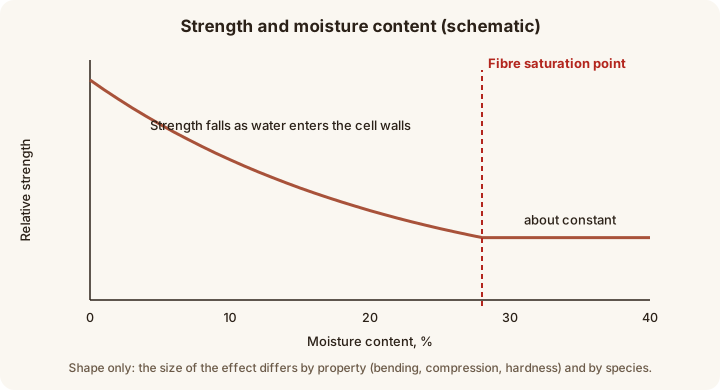 Schematic: strength and stiffness rise as moisture content falls below the fibre saturation point, and are roughly constant above it. The curve shape is illustrative.
A literature review by Gerhards in Wood and Fiber Science (1982) concluded that the mechanical properties of clear wood increase as moisture content falls below the fibre saturation point, with the trend holding at least down to about 5 % MC, and that properties also increase as temperature decreases.
How big is the effect? A set of notes by Alpo Ranta-Maunus (VTT, 2001) gives approximate percentage changes in a property for each percentage point of MC between 8 % and 20 % (European practice, EN 384):
| Property | Approx. change per 1 percentage point MC |
|---|---|
| Compression strength (the table row covers parallel and perpendicular), clear wood | about 5 % |
| Compression strength, sawn timber (EN 384) | about 3 % |
| Bending, clear wood | about 4 % |
| Bending, sawn timber | about 0 % |
| Tension parallel, clear wood | about 2.5 % |
| Tension parallel, sawn timber | about 0 % |
| MOE parallel, two values given (1.5 % and 2 %); the column labels are garbled in the source, so which applies to clear wood, round timber or sawn timber is uncertain | about 1.5 % and 2 % |
Two lessons follow. First, in structural-size timber the weak points (knots, grain deviations) control failure, and those weak points react less to moisture than clean wood does (our reading; the notes say the lowest 5th percentile of sawn timber is barely affected by moisture); according to those notes, in EN 384 no adjustment is used for bending and tension strengths, only for compression. Second, the notes state that properties of high-quality material are affected more by moisture than those of low-quality material. The same notes say that clear wood reaches maximum strength at around 10 % MC as a rule of thumb, and that drying much further may not help and can reduce strength, depending on species and loading direction.
Practical consequence (my arithmetic, 8 points x 1.5-2 % per point): a board dried from 20 % to 12 % gains stiffness of roughly 12–16 % on these figures, but little in the bending strength that matters at the weakest knot. Design codes also use moisture-based modification factors. As an example, a US design-value course (based on the 2010 National Design Specification) uses wet-service factors for dimension lumber of 0.85 for bending and 0.67 for compression perpendicular to grain when MC exceeds 19 % (the same table gives other factors for other properties, and the factor is 1.0 at low stress levels).
Grain angle and knots
Slope of grain. Strength is highest when the load follows the fibres. When the fibres deviate from the axis of the board, because the tree was spiralled or the board was sawn off-axis, strength drops quickly. The Canadian lecture lists the remaining fraction of straight-grain strength as 93 % at a slope of 1 in 20, 81 % at 1 in 10 and only 55 % at 1 in 5; the lecture's table does not say which strength property these refer to, and I could not open the Wood Handbook table (which lists values by property) to resolve this. Hankinson-type formulas describe this with an exponent: the lecture gives n of about 1.5–2.0 for tension and bending strength (MOR), 2.0–2.5 for compression and about 2.0 for MOE. Larger n means a steeper penalty.
Knots. A knot is the base of a branch embedded in the stem. It reduces strength because it breaks the continuity of fibres, deflects the surrounding grain and, in tension zones, concentrates stress. Its effect depends on size, position and type. A knot near the edge of the tension side of a beam is generally more harmful than one in the middle or in a low-stress region; a trade article summarising the Handbook (Journal of Light Construction) says knots affect axial tension more than short-column compression and that a knot on the tension side of a simply supported beam matters more than one on the compression side.
Grading engineers express the combined effect as a strength ratio: the strength of the piece with defects divided by the strength of straight-grained clear wood. The Canadian lecture defines the strength ratio this way and, on an edge-knot slide, shows 67 % for the Select Structural grade (the slide does not label the figure; I read it as a strength ratio), which gives a feel for the loss even in a top visual grade.
A Lithuanian study (Baltrušaitis and Pranckevičienė, 2003) of about 4000 m³ of visually graded pine and spruce at a sawmill found that knots, distortion and fissures predetermined the grade in 62.4 % of cases, sawing accuracy and drying quality together in 24.1 %, that the upper-grade share decreased for thicker boards, and that spruce gave a slightly higher yield of the upper grade than pine, mostly because of smaller knots. That is a useful reminder that sawing and drying practice, not just the log, control the grade outcome.
Temperature and duration of load
Temperature. Cold wood is stronger and stiffer, warm wood weaker (Gerhards, a review of clear-wood data). Ranta-Maunus states that when the temperature is above 60 °C the exposure degrades wood and the strength is permanently reduced (long-term exposure); that structures rarely reach such temperatures is my remark.
Duration of load. Wood loaded steadily can fail at a load below its short-term strength, so design codes reduce strength for long loads. The classic empirical description is the Madison curve, which the Canadian lecture notes was built on tests whose longest duration was seven years. Design codes translate this into load-duration factors. In the 2010 US National Design Specification as summarised in a course text, allowable values assume a normal duration of 10 years (factor 1.0), with 0.9 for permanent loads, 1.15 for two months (snow), 1.25 for seven days, 1.6 for ten minutes (wind or earthquake) and 2.0 for impact; the factor does not apply to stiffness. The Canadian lecture lists K_D of 1.15 for short term, 1.0 for standard term and 0.65 for long term. The US source says the factors do not apply to the modulus of elasticity. Different codes use different numbers, so never transfer a factor from one system to another.
Moisture interacts with load duration. Ranta-Maunus reports four-week tests on uncoated specimens (curved beams, tension perpendicular to the grain) where cyclic humidity gave a load-duration factor of 0.45–0.66 against about 0.8 in similar experiments at constant humidity; the authors attribute the difference to moisture gradients. A sawmill supplying wet or fluctuating-condition products should understand that "dry and stable" is part of the strength specification.
Clear wood versus structural size
The numbers in the previous sections are for clear wood. Structural lumber is different in three ways.
- Defects govern. Knots, slope of grain, pith, compression wood and wane control failure (general knowledge; the Lithuanian study names knots, distortion and fissures), so average strength is a fraction of clear-wood strength.
- Design uses low percentiles. The Canadian lecture states that strength design values are the 5th percentile with 75 % confidence, while stiffness values use the mean. A 5th-percentile value is exceeded by about 95 of 100 pieces.
- Size matters. Characteristic values depend on the cross-section; the Lithuanian paper applies a size factor (kh) from EN 384 when computing proof stress for a 150 mm reference depth, and attributes lower upper-grade yield in thicker boards partly to a scale-factor effect.
This is why a "105 MPa oak" in a table does not mean structural oak beams are rated at 105 MPa. That characteristic bending strengths in structural standards are far lower than mean clear-wood MOR is my expectation from the 5th-percentile basis; I did not read EN 338 tables to confirm numbers.
Visual grading, machine grading and strength classes
Visual grading assigns pieces to grades by inspecting knots, grain slope, wane, fissures and distortion against written limits. It is the oldest method, cheap and transparent, but it relies on features that correlate only moderately with strength. The Lithuanian study used the British standard BS 4978 with two grades, General Structural (GS) and Special Structural (SS); 69 % of the timber was graded GS and 31 % SS.
Machine grading measures a property, usually stiffness (by bending or by vibration/ultrasound) and sometimes density or X-ray information, and uses it as an indicating property for strength. In the Lithuanian paper, pieces were sorted by stiffness limits into strength classes.
European framework. EN 14081-1 (Timber structures – Strength graded structural timber with rectangular cross section – Part 1: General requirements) specifies requirements for visually or machine-graded timber, including mechanical resistance, test methods, conformity assessment and marking. Per the catalogue scope of the 2016+A1:2019 edition, the timber must meet the dimensional requirements of EN 336, and the standard excludes fire-retardant-treated timber, thermally or chemically modified timber and structural finger-jointed timber. EN 338 (Structural timber – Strength classes) establishes the system of strength classes for general use in design codes and gives characteristic strength and stiffness properties and density for each class to which EN 14081-1 refers; each class is designated by a number indicating the edgewise bending or tension strength in N/mm² (catalogue wording). EN 384 (Structural timber – Determination of characteristic values of mechanical properties and density) is a normative reference. The 2016 edition supersedes EN 338:2009. The Lithuanian paper used the older LST EN 338:2000, whose Table 1, as quoted there, lists stiffness thresholds from below 7000 N/mm² (C14) to above 12 000 N/mm² (C30); the paper's own test data cover only C14 to C27. I could not read the 2016 class tables in an authoritative open source, so I give no class values here: check the current edition and its status before you quote values to a customer.
Practical rules of thumb for sawmills
- Treat tabulated clear-wood MOR and MOE as upper bounds, not as grading values.
- For stiffness, 1 percentage point of MC is worth roughly 1.5–2 % MOE between 8 % and 20 %; for bending strength in structural sizes it is nearly irrelevant.
- Sort for grain slope: 1 in 10 costs about 20 % of straight-grain strength and 1 in 5 about 45 %.
- Control sawing accuracy and drying distortion: in the Lithuanian study they decided about a quarter of grade outcomes.
- Quote the standard edition and grading rule with any strength class.
What is uncertain or varies
- Percent-per-MC figures are approximations from one set of notes, vary by species and loading direction, and are for the 8–20 % range only.
- Grain slope and knot ratios come from a teaching lecture and apply to particular grading rules; European visual rules differ.
- Duration-of-load factors differ between the US, Canadian and European codes, and the Madison curve rests on tests of limited duration (seven years at most) extrapolated to decades.
- Species values are averages of specimens from specific regions and decades.
- Strength classes: I verified the scopes of EN 338 and EN 14081-1 only from catalogue summaries; no 2016 class values were read from an authoritative open source, and the stiffness limits quoted are from the 2000 edition as printed in the Lithuanian paper.
- Slope-of-grain table: the percentages come from the Canadian lecture with the property unnamed; the Wood Handbook table could not be opened. The 67 % figure is not labelled in the lecture.
- Region: most numbers are North American (US Wood Handbook, NDS, Canadian lecture); European items are EN 338/14081-1 scopes, the Finnish VTT notes and a Lithuanian grading study.
Key points
- MOR is bending strength, MOE is stiffness; compression, tension and shear along the grain far exceed their cross-grain values.
- Below about 28–30 % MC, wood gets stronger and stiffer as it dries, but structural-size bending and tension are barely affected.
- Sloping grain and knots reduce strength sharply: 1 in 10 slope leaves about 81 % (property unnamed in the lecture), and the lecture shows a strength ratio of about two thirds (67 %) for Select Structural.
- Strength falls under sustained load and with hot, wet service; load-duration factors differ by code.
- Design values are low percentiles of structural-size tests, not averages of clear specimens.
- Visual and machine grading both feed the EN 338 strength classes through EN 14081-1; sawing and drying quality influence the yield of each class.
How this text was checked · checked 2026-10-26
Re-opened the CED copy of Wood Handbook ch. 5 (partial), the CWC lecture, Ranta-Maunus (VTT), Gerhards abstract, the Lithuanian grading paper, the NDS course and the EN 338/EN 14081-1 catalogue entries; tried but failed to open a full Handbook ch. 5 (Treesearch download blocked by robots, other copies lacked the grain/knot sections).
Corrections made during checking
- Douglas-fir (coast) MOR is 85 MPa in the Handbook table, not 85.5; yellow-poplar 70 MPa (69.6 was the inch-pound conversion).
- Ranta-Maunus table: the compression row covers parallel and perpendicular; the two MOE values (1.5 and 2 %) have garbled column labels, so the 'clear wood / sawn timber' assignment was removed.
- 'Humidity cycling roughly doubled the load-duration effect' was an over-claim; replaced by the reported factors 0.45-0.66 vs about 0.8 (tension perpendicular, four-week tests).
- Gerhards is a literature review and says 'at least down to about 5 % MC'; 'reversible with temperature' removed (not in abstract).
- 'Remaining 93/81/55 %' of strength: the lecture does not name the property; stated. 67 % Select Structural is an unlabelled slide figure; stated as my reading.
- Stiffness ratio 20:1.6:1 is a ratio of moduli of elasticity; wet-service factors scoped to dimension lumber with 1.0 at low stress; load-duration factors do not apply to MOE (US source).
- 'Eventually fail at a load well below short-term strength' softened; Madison curve 7-year limit kept.
- EN 338: removed 'edition now in force'; catalogue says 2016 supersedes 2009; naming and scope wording aligned with catalogue; EN 14081-1 scope extended with EN 336 and fire-retardant exclusion; no class values added because only a secondary transcription was found.
- Knot tension/compression statement attributed to a secondary trade source; claim that standards values are 'far lower' than clear MOR marked as expectation.
- Lithuanian study details (4000 m3, 69 % GS / 31 % SS, classes tested C14-C27) added.
Could not be verified
- Handbook table of strength vs slope of grain and the knots section (not opened).
- EN 338:2016 class values and current status of the edition.
- Which property the 93/81/55 % slope-of-grain percentages refer to.
- Madison curve details beyond the lecture's 7-year statement.
- Effect of pith, compression wood and wane on structural strength (general knowledge only).
Sources
- Wood Handbook ch. 5, Mechanical Properties of Wood (FPL-GTR-190, course reproduction)
- Chui: Physical and Mechanical Properties of Wood, Lecture 1 (Canadian Wood Council / Univ. of Alberta)
- Ranta-Maunus: Effects of climate and climate variations on strength (VTT, 2001)
- Gerhards (1982): Effect of moisture content and temperature on mechanical properties of wood, Wood and Fiber Science 14(1)
- Baltrusaitis, Pranckeviciene (2003): Strength grading of the structural timber, Materials Science 9(3)
- Determining Allowable Design Values for Wood (course based on the 2010 NDS)
- SIST EN 338:2016 Structural timber - Strength classes (catalogue entry)
- EN 14081-1:2016+A1:2019 Strength graded structural timber (catalogue entry)
- Journal of Light Construction, The Strength of Wood (Understanding Wood series, 2020) - secondary trade article summarising the Wood Handbook on knots
Last updated 2026-10-26