Wood science
Moisture in Wood: Bound and Free Water, the Fibre Saturation Point and How to Measure Moisture Content
How water is held in wood, what the fibre saturation point (about 30 % MC per the Wood Handbook) does and does not mean, dry versus wet basis, equilibrium moisture content and hysteresis, and the limits of oven-drying, resistance and capacitance meters, with sawmill and kiln consequences.
Country / region of the study or data: Mostly North America (USDA Wood Handbook data for US species and US climates; University of Wisconsin-Extension and University of Kentucky guides). European items: the Cellulose 2025 fibre saturation paper (record hosted at Lund University, Sweden; co-authored by the authors of the 2021 Wood Handbook moisture chapter) and a Holzforschung 2011 abstract on Norway spruce.
Why this matters in the sawmill
Most quality complaints a sawmill receives are, at root, moisture problems: cupped boards, flooring that opens gaps in winter, failed glue lines, stain under wrapping, mouldy pallets. In each case the wood was at a different moisture content from the one it met in service, and it moved, or was attacked biologically, while it adjusted. Drying is also the heaviest step in the production chain in energy terms. Bergman (Wood Handbook chapter 13, 2021 edition, FPL-GTR-282, in a course adaptation we cite below) notes that kiln drying consumes the most energy of any wood-processing step, which is one reason air drying to roughly 20-25 % moisture content before kilning is common where time and yard space allow.
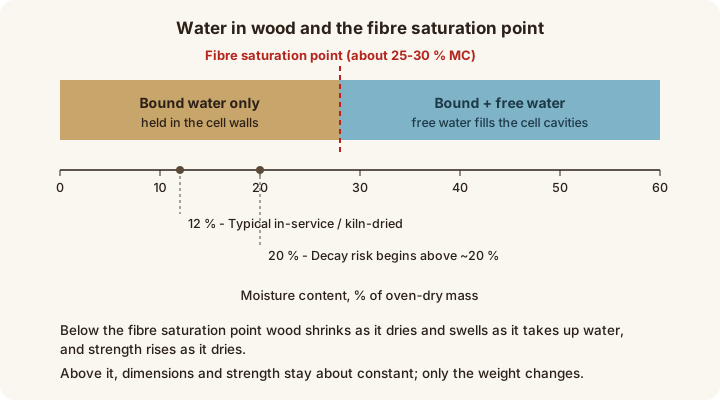
Free water fills the cell cavities and leaves first; below the fibre saturation point, bound water in the cell walls is lost and the wood begins to shrink.
To manage that step you need four ideas that are easy to state and easy to confuse: where the water sits in the wood, what the fibre saturation point does and does not mean, what the percentage on a delivery note is a percentage of, and how the surrounding air decides the moisture level dried wood will settle at.
Bound water, free water and the fibre saturation point
Wood is a porous solid. Its cell walls consist mostly of cellulose, hemicelluloses and lignin, and inside each cell is an empty space, the lumen. The Wood Handbook chapter on moisture relations (USDA Forest Products Laboratory; we read it as reproduced in an engineering course by CED Engineering) calls water in the lumens and other cavities free water: liquid or vapour held by capillary forces. Water inside the cell wall is bound water, held to the wall polymers by intermolecular attraction.
The distinction matters because the two behave differently. Removing free water is comparatively easy and changes almost nothing about the wood: the piece gets lighter but does not shrink. Removing bound water takes more energy and draws the cell walls together, so dimensions shrink and, in general, strength and stiffness rise. In the classic simplified picture, free water leaves first when green wood dries, and bound water is lost afterwards; the handbook itself notes that the transition is gradual and that lumens can be empty while the cell walls are still partly wet.
The fibre saturation point (FSP) is the label for the boundary: the moisture content at which the cell walls are saturated with bound water while the lumens hold no liquid. The Wood Handbook states that the FSP averages about 30 % moisture content and may differ by several percentage points between species and between pieces. Above it, physical and mechanical properties generally stop changing with moisture. Bergman uses 30 % for most species when estimating shrinkage but gives about 22 % for four entries in his Table 13-5: northern white cedar, western redcedar, and old-growth and second-growth redwood. So the often-quoted 25-30 % band is a convenient range rather than a constant: the handbook says "about 30 %", and some species sit lower.
Two consequences follow. In the simple model a green board at 80 % and one at 40 % have the same dimensions; shrinkage starts only as the surface, and later the core, pass through the FSP. And a drying board is not uniform: its surface can be well below the FSP and shrinking while its core is still above it. That gradient is the root cause of drying stress and checking, discussed below.
A caution about the term itself
Fredriksson, Thybring, Zelinka and Glass (Cellulose, 2025) explain that the term was coined in the early twentieth century for the transition between a moisture range where wood properties change and one where they stay constant, under a model in which the cell walls are exactly saturated at that transition and capillary water appears only above it. According to the authors, multiple studies have contradicted that assumption, and different techniques associated with the FSP measure different moisture states. They propose reserving "fibre saturation point" for the property transition (offering "property intersection point" as a clearer name that can be specified further, for example for strength or shrinkage) and calling the water-saturated cell wall state the "maximum cell wall moisture content". The paper (Cellulose 32(5), 2901-2918, open access) recommends using the property intersection point for kiln drying, dimensional stability and structural uses. For a sawmill the working conclusion is modest: 30 % remains a sensible planning figure, but treat it as an engineering convention with scatter, not a sharp physical switch.
Moisture content and its two bases
When someone says "the boards are at 18 %", the first question is: 18 % of what? The wood industry's standard is the dry basis: moisture content is the mass of water divided by the mass of oven-dry wood, times 100, or MC = (m_wet - m_dry) / m_dry x 100. Bergman gives this form and notes that most wood products use it, whereas wood fuels are commonly quoted relative to the original mass including the water.
The two bases give different numbers for the same piece. Dry-basis values are always the higher, and they have no upper limit. The Wood Handbook illustrates this: the maximum moisture content a piece can hold with all its pores full depends on density, from about 267 % at a basic specific gravity of 0.30 down to about 44 % at 0.90. A light softwood can therefore exceed 100 % on the dry basis, which is impossible on a wet basis.
Converting is plain arithmetic, independent of any source: wet-basis MC = dry-basis MC / (100 + dry-basis MC) x 100, and dry-basis MC = wet-basis MC / (100 - wet-basis MC) x 100. A piece at 25 % dry basis is at 20 % wet basis; 100 % dry basis equals 50 % wet basis. For biomass contracts always state the basis; for lumber and kiln work dry basis is the convention.
Equilibrium moisture content, humidity, temperature and hysteresis
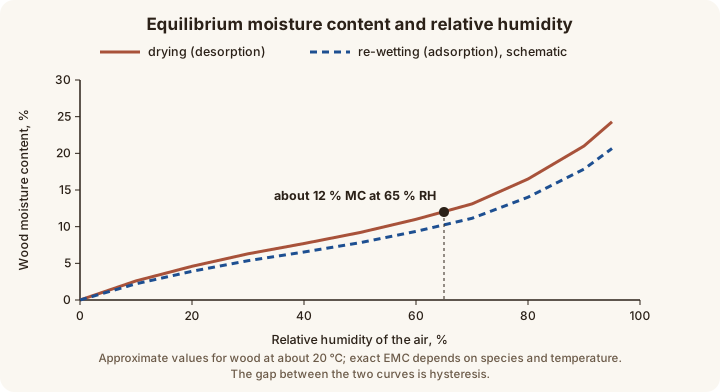
Approximate EMC at about 20 °C: drying (solid) and re-wetting (dashed, schematic). Check exact values for your species and temperature in published EMC tables.
Wood is hygroscopic. Held in air of constant relative humidity (RH) and temperature, it gains or loses water until it reaches an equilibrium moisture content (EMC). RH is the dominant control. The Wood Handbook table for 21.1 degrees C (70 degrees F; 2010 edition, derived primarily for Sitka spruce but said to apply to wood of any species for most practical purposes) gives about 1.3 % EMC at 5 % RH, 4.5 % at 20 %, 7.7 % at 40 %, 9.2 % at 50 %, 11.0 % at 60 %, 16.0 % at 80 %, 20.5 % at 90 % and 23.9 % at 95 %. At 65 % RH the same table gives 12.1 % at 15.6 degrees C and 12.0 % at 21.1 degrees C, so a five-degree change barely moves the equilibrium there. Conners (University of Kentucky) states the general rule: EMC is more sensitive to RH than to temperature.
Target moisture contents therefore follow climate and use. Bergman's chapter gives, for interior use, an average of about 8 % (6-10 % for individual pieces) across most of the United States, about 6 % (4-9 %) in the dry Southwest and about 11 % (8-13 %) in damp, warm coastal areas; for exterior use about 12 % on average (9-14 % individually) in most areas, with 9 % in the Southwest and 12 % on the coast. Typical kiln targets he lists are framing softwood averaging 15 % and not above 19 %, appearance softwood 10-12 %, furniture, cabinet and millwork stock 7-9 %, and hardwood furniture, flooring and millwork 6-8 %.
Hysteresis: the same air, two answers
Equilibrium is not unique. The handbook explains that EMC depends on history: wood approaching a given RH by losing water (desorption) ends up more moist than wood approaching it by gaining water (adsorption). The ratio of adsorption to desorption EMC averages about 0.8 near room temperature, and the very first drying of green wood gives a higher EMC than later cycles. The published EMC table is a practical compromise for cases where the direction of approach is unknown. A 2011 Holzforschung study of Norway spruce sapwood (60 to 99.9 % RH; the portal read only the abstract) found that oven-drying at 103 degrees C caused a larger loss of hygroscopicity than vacuum drying at room temperature, and argued that earlier second-desorption curves were not true boundary desorption isotherms. It is a reminder that hysteresis values depend on the drying history of the sample.
How moisture content is measured
Oven-drying: the reference
The oven-dry method follows the definition. According to Bergman, ASTM D4442 Method A takes specimens at least 500 mm from the board end, free of knots, bark and pitch pockets; a lumber specimen is a full cross-section about 25 mm long. It is weighed at once, dried at 101-105 degrees C and re-weighed until mass changes by no appreciable amount over 3-hour intervals, typically 12-48 hours for a 25 mm section. Conners advises against microwave ovens, whose end point is unreliable.
The method is accurate and widely accepted but slow and destructive, and Bergman warns that it can slightly overestimate moisture in woods with volatile extractives, since lost compounds are counted as water. Its role is to calibrate everything else and settle disputes, not to steer production.
Resistance (pin) meters
A resistance meter drives two pins into the wood, measures electrical resistance or conductance between them, and converts it to moisture content with a calibration curve. Boone and Wengert (University of Wisconsin-Extension) give a working range of about 7-30 % MC (Bergman about 6-30 %; Conners 7-28 %, quoting a meter manufacturer, Delmhorst, for an accuracy that loosens from +/-0.5 % at 6-12 % to +/-2 % at 20-30 %). The sources differ at the margins, so consult your instrument's manual. Their shared message is what matters: above about 30 % readings are not reliable. Boone and Wengert state that above 30 % the electrical resistance has too much variability and too little change for reliable readings.
Further limits from these sources: pins driven to about one fifth to one quarter of the thickness (Bergman), or 20-25 % (Conners), give an average reading, while shallow pins read the surface layer; most US meters are calibrated for Douglas-fir or southern pine, with corrections for other North American species usually 1 % MC or less and larger for some tropical woods (Boone and Wengert). Bergman gives roughly 0.5 % MC per 10 degrees F of deviation from the calibration temperature for resistance meters.
Capacitance and dielectric meters
Non-pin meters press a sensor plate on the surface and measure a dielectric property such as capacitance or power loss in the field the plate projects. They are fast and leave no holes, which suits incoming inspection and grading lines. Reported ranges are about 5-30 % (Boone and Wengert), 4-30 % (Bergman) and 5-25 % (Conners). Their key weakness is density: Boone and Wengert report that non-pin meters are strongly affected by specific gravity, so species settings should be used where available. A surface-sensing meter probably also sees mainly the outer layer, so a wet core under a dry shell could go unnoticed (portal inference; not stated in the sources opened).
Bergman states that, used properly on lumber dried below the FSP, electrical meters should give an average within about 1 % of the true average.
From numbers to decisions in the kiln and yard
Moisture content drives dimensional change and defects. The Wood Handbook assumes that shrinkage starts at the FSP (30 % if unknown) and that dimensions then fall linearly with moisture content, ending at the species' green-to-oven-dry shrinkage. For the common service range of 6-14 % MC, Bergman gives a simpler form: change in dimension = initial dimension x coefficient x change in MC. For flat-grained white fir the tangential coefficient is 0.00245 per percentage point, so a 232 mm board moving from 8 % to 11 % MC grows by about 1.7 mm (Bergman's worked example). The handbook adds that the linear total-shrinkage equation tends to underestimate true change by about 5 %; the change-coefficient method was developed for the 6-14 % range to avoid that problem, so the 5 % does not apply to the worked example.
Gradients produce stress. As a board dries, the shell goes below the FSP first and tries to shrink while the wetter core resists. The shell is put in tension and cracks if it dries too fast: surface checks, which Bergman notes are most common on flat-sawn faces and Conners links to fast drying, high air speed and wet-dry cycling. End checks arise because moisture moves along the grain 10-15 times faster than across it (Bergman), so ends dry first; the handbook says, in the context of factory storage, that an equilibrium moisture content 4 % or more below the core moisture content of freshly crosscut boards can cause end checking, and end coatings help. Internal honeycomb cracks can form later, usually from excessive temperature and time.
Practical rules of thumb for sawmills
- Always state the basis. Write "MC, dry basis" or "wet basis" in specifications, kiln logs and biomass sales, and never compare figures across the two.
- Use about 30 % as the working FSP for shrinkage and drying calculations unless you hold species-specific data.
- Do not rely on any electrical meter above about 30 % MC. Use the oven-dry method (101-105 degrees C to constant mass) for green wood and for disputes.
- Use pins for averages on dried stock and dielectric meters for fast surface screening, setting species and temperature corrections each time.
- Set the target MC for the destination climate, not one universal number.
- Dry gently while the surface passes through the FSP, because that is where the shell-to-core gradient is steepest.
What is uncertain or varies
- The FSP is not a single fixed number. The handbook says about 30 % with several points of variation, and the 2025 Cellulose paper argues that the classic definition conflates two different moisture states. Neither source forbids 30 % as a working figure.
- We found no source we could open that quantifies the temperature dependence of the FSP, so we make no claim about it.
- Meter accuracy ranges differ between sources (lower limits 4-7 %, upper limits 25-30 %); manufacturers' current specifications take precedence.
- The EMC, kiln-target and correction figures come from North American, mostly US Forest Service and US extension, material (the 2010 edition of the Wood Handbook moisture chapter; the 2021 edition, FPL-GTR-282 chapter 4, could not be opened). European species and standards have their own tables that we did not open; the only European items used are the Cellulose 2025 FSP paper and the Holzforschung 2011 abstract on Norway spruce.
- The Boone and Wengert guide is from 1998 and the Conners manual is undated in the text we read; manufacturers' current specifications may differ.
- The 0.8 hysteresis ratio is an average near room temperature; individual species and temperatures vary.
Key points
- Free water sits in the lumens; bound water sits in the cell walls. Only loss of bound water makes wood shrink and stiffen.
- The fibre saturation point averages about 30 % MC per the Wood Handbook, varies by several points, and is better seen as a property transition than a sharp boundary.
- Industry moisture content is dry basis, can exceed 100 %, and must always be labelled.
- EMC is driven mainly by RH: at about 21 degrees C the handbook table gives 7.7 % at 40 % RH and 16.0 % at 80 % RH.
- Hysteresis means adsorption EMC is roughly 0.8 of desorption EMC.
- Oven-drying is the reference; electrical meters are reliable only below about 30 % MC and need species and temperature corrections.
- Moisture gradients, not just averages, cause checking and other drying defects.
How this text was checked · checked 2026-10-26
Re-opened the Wood Handbook moisture chapter (2010 reproduction), Bergman's drying chapter (2021 edition adaptation), Boone and Wengert, Conners and the Cellulose 2025 paper page, and compared every number and attribution; the Treesearch PDF of the 2021 chapter 4 is blocked to automated fetching.
Corrections made during checking
- Shrinkage start at 22% applies to four named entries (northern white cedar, western redcedar, two redwoods), not to cedars and redwood generally.
- 'Free water leaves first' no longer attributed to the handbook as such; handbook only notes gradual transition and empty lumens with wet walls.
- The 5% underestimation belongs to the total-shrinkage equation, not the white fir worked example; the coefficient method avoids it.
- End-check rule (4% below core) is stated in a factory-storage context, not as a general drying rule.
- 'Qualitative above 30%' replaced by the source wording (too much variability, too little change for reliable readings).
- Conners' accuracy figures identified as a manufacturer (Delmhorst) quotation.
- Capacitance-meter 'wet core under dry shell' relabelled portal inference.
- Added EMC at 5% and 50% RH, EMC table basis (Sitka spruce, any species), regional ranges for interior/exterior targets (Southwest 4-9%, coastal 8-13%; exterior SW 9%).
- Added 'property intersection point' terminology and recommendations from Fredriksson et al. 2025; added a European (Norway spruce) hysteresis note; edition and region statements added.
Could not be verified
- 2021 Wood Handbook chapter 4 (Glass and Zelinka) could not be opened; EMC, FSP and shrinkage values are from the 2010 edition reproduction.
- Holzforschung 2011 study read as abstract only; authors not captured.
- Temperature dependence of FSP: no opened source quantifies it.
- Conners manual publication date and current meter manufacturer specifications not checked.
- Statement that surface-sensing meters miss a wet core is a portal inference.
Sources
- Wood Handbook, Chapter 4: Moisture relations and physical properties of wood (USDA Forest Products Laboratory; course reproduction by CED Engineering)
- Glass & Zelinka, Moisture relations and physical properties of wood, Wood Handbook FPL-GTR-282 (2021), Treesearch record
- Bergman, A Guide to Wood Drying, Moisture Content and Dimensional Changes (Wood Handbook chapter 13; CED Engineering adaptation)
- Boone & Wengert, Guide for Using Portable Electric Moisture Meters on Lumber (University of Wisconsin-Extension, 1998)
- Conners, Hardwood Dry Kiln Operation: A Manual for Operators of Small Dry Kilns (University of Kentucky)
- Fredriksson, Thybring, Zelinka & Glass, The fiber saturation point: does it mean what you think it means? (Cellulose, 2025), record
- Equilibrium moisture content (EMC) in Norway spruce during the first and second desorptions (Holzforschung 65(6), 2011; abstract only)
- Fredriksson and others, The fiber saturation point (Cellulose 2025), publisher page
Last updated 2026-10-26