Wood science
Wood Variability: Juvenile Wood and Growth Rate
How density, microfibril angle, cell length and stiffness change from pith to bark and from butt to top, and what growth rate, thinning and site do to them. Figures from Finland, Sweden, Germany, Britain, British Columbia and Japan, with caveats.
Country / region of the study or data: Europe (Finland, Sweden, Germany, Britain: Norway and Sitka spruce); North America (British Columbia lodgepole pine); Japan (loblolly pine, a North American species); New Zealand (radiata pine, abstract only)
Why this matters in the sawmill
Two logs of the same species and diameter can saw into very different timber. One produces stiff, straight, stable boards; the other produces boards that pass visual grading but fail the stiffness limit, or that twist and bow in the kiln. Most of that difference is variability inside the tree and between trees: where in the stem a board came from, how fast the tree grew, and how it was managed. Understanding the pattern lets a mill predict grade yield, sort logs sensibly, and set realistic expectations for fast-grown plantation wood.
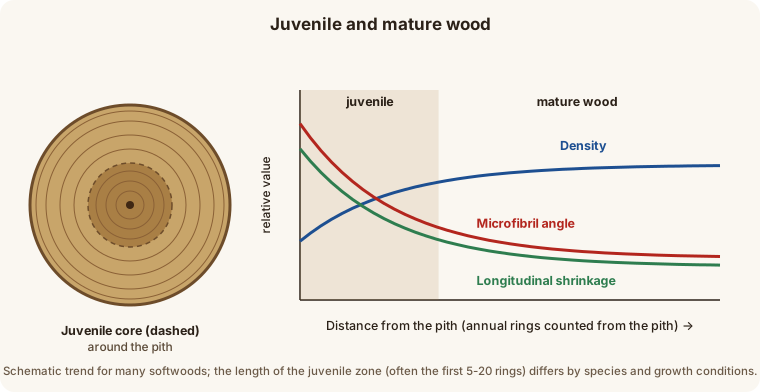
Figure: schematic of property change with distance from the pith. Juvenile wood near the core has lower density, larger microfibril angle and shorter cells; the transition to mature wood is gradual and differs between properties and species.
Numbers below are tagged by region and species. Lodgepole pine data are from British Columbia (North America); the loblolly pine data are a North American species grown in Japan; Norway spruce data are from Finland, Sweden and Germany and Sitka spruce data from Britain (Europe); the radiata pine reference is from New Zealand. The US Wood Handbook (Forest Products Laboratory) was not consulted for this article, so no value here comes from a particular edition of it. All figures are from the single studies named, each valid only for its own species, sites and methods.
Juvenile and mature wood: what changes from the pith outward
A tree's cambium produces wood whose character changes as the cambium ages and as the crown develops. The first rings around the pith, formed when the tree is young and has a large live crown, are called juvenile wood (or corewood). Compared with the mature wood further out, juvenile wood typically has lower density, shorter cells, a larger microfibril angle (MFA, the angle at which cellulose microfibrils wind in the main cell-wall layer), and higher longitudinal shrinkage.
A well-documented example is loblolly pine grown in Tochigi, Japan. In five 40-year-old trees from the Funyu Experimental Forest, with the boundary taken at the 14th ring from the pith (the boundary ranged from the 14th to the 19th ring across trees), Tanabe and colleagues (2016, Forest Products Journal) reported for juvenile versus mature wood: basic density 0.33 versus 0.38 g/cm3; S2-layer MFA 26.4 versus 17.7 degrees; latewood tracheid length 3.02 versus 4.33 mm. Lumber was classified as juvenile or mature by an annual ring width threshold of 5.0 mm (a different criterion from the ring-14 boundary). Juvenile lumber (n = 60) had a mean static MOE of 4.56 GPa, a bending strength (MOR) of 40.7 MPa and an air-dry density of 0.47 g/cm3; mature lumber (n = 22) had 6.53 GPa, 51.3 MPa and 0.49 g/cm3. By our own calculation from these means, juvenile lumber had about 30 percent lower MOE and about 21 percent lower MOR, with only about 4 percent lower density. This is a North American species grown in Japan from a small sample of five trees; the direction of the pattern is typical for pines but the values are not general.
For Norway spruce in Finland, Jyske, Makinen and Saranpaa (2008, Silva Fennica) sampled 85 trees from central and south-eastern Finland. Density rose from the pith outward, mainly because latewood density and latewood percentage rose, while earlywood density rose only slightly; the earlywood-latewood density difference was smaller in rings near the pith. One reading of this (our interpretation, not a statement of the paper) is that juvenile wood in spruce is not only less dense but less contrasty, with a weaker latewood band.
Different properties mature at different rates, so there is no single "juvenile wood boundary". In lodgepole pine in central British Columbia (60 trees, three age classes, four sites; North America), Mansfield and colleagues (2009, Holzforschung) estimated the transition at about 15 years for MFA, about 18 years for tracheid length and about 31 years for wood density. The timings of fibre length and MFA were moderately related (r = 0.52), while density timing was only weakly related to either (r = 0.07 and 0.16). A mill that defines juvenile wood by a fixed ring count is therefore using a convention, not a biological fact. Vihermaa (2010, University of Glasgow thesis, Britain) used ring 10 from the pith as the juvenile boundary for Sitka spruce profiles, which is an analysis choice, and Napier University's Centre for Wood Science and Technology describes UK Sitka core wood as formed while the cambium is under about 15 years old.
Wood from the core is not the only factor. Burdon and co-authors (2004, New Zealand Journal of Forestry) argued that, in radiata and loblolly pine, wood near ground level has distinctive properties even when compared at the same ring number from the pith. They propose two separate axes: a radial one (corewood to outerwood) and a vertical one (juvenile to mature, as the tree and crown develop). The boundary of juvenile and mature behaviour is therefore not a cylinder around the pith but varies with height. Those authors link the vertical differences to changes in branch habit, and so to knot characteristics, and describe a conflict: the basal juvenile wood has poor stiffness, yet its knot pattern would suit structural use in unpruned material; in radiata pine its low stiffness points it towards appearance grades, but it is susceptible to instability and internal checking when drying. The abstract suggests that careful segregation of juvenile wood during processing may greatly reduce these conflicts (New Zealand; abstract only, the full text was not available).
Earlywood, latewood and ring width
In softwoods, each ring has a lower-density earlywood zone and a denser latewood zone. Density at the ring or board level is largely the proportion and density of latewood. Within the Finnish spruce sample, differences between annual rings accounted for 11 to 27 percent of the total density variation, differences between stem heights for 3 to 6 percent, and the variation inside annual rings for 49 to 80 percent (Jyske et al. 2008, Europe). That last number is large because density oscillates across each ring, so averages at board scale hide a lot.
Ring width is often used as a grading proxy, but it is a proxy for radial position and for density rather than for tree growth rate. Napier University's Centre for Wood Science and Technology notes that in Sitka spruce faster ring growth means proportionally more low-density earlywood, while in some hardwoods the relationship can be the reverse. It also cites the old judgement of Hartig (1885) that ring width alone is a dubious indicator of wood quality.
Growth rate, silviculture and site
Fast growth does not mean poor wood in all species, but in spruce and many pines it tends to mean lower density, because more earlywood is formed. In an analysis of Swedish Norway spruce fertilised and irrigated trials, Lundgren (2004, Silva Fennica) found that more than a doubling of ring width went with only about a 20 percent decrease in density, so dry matter production still rose, but fertilised trees had a higher MFA and lower density, which lowered calculated wood strength. The point for sawmills is that a large increase in growth is paid for with a smaller, but real, loss in density and stiffness, and the MFA effect compounds it.
German softwood data illustrate how strong the link can be. In a case study of 100 dominant and co-dominant Norway spruce trees (20 per stand, five plots in two forest districts in Hesse and Lower Saxony, Germany) with two silvicultural systems (Höwler et al. 2022, Forests; Europe), mean annual ring width correlated strongly and negatively with density (Spearman rho = -0.754). The plot with the narrowest rings (about 1.78 mm, an 80-year-old stand thinned from below) had a mean density at breast height of 511 kg/m3, a mean bending strength of 51.8 N/mm2 and a median MOE of about 15,900 N/mm2; the plot with the widest rings (about 3.74 mm, a 40-year-old stand thinned from above) had 415 kg/m3, 22.0 N/mm2 and about 7,830 N/mm2. This is a striking contrast, but the authors state that each site had only one treatment, the sample was small and only the lowest 12 m of stem was analysed, and they describe it as a case study with limited upscaling, so age, site, treatment and juvenile-wood share are confounded. In their mixed-effects model, thinning from below was associated with about 49.5 kg/m3 higher density at breast height than thinning from above after accounting for ring width.
In Britain, Napier's Centre for Wood Science and Technology reports that yield class 14 is typical for Sitka spruce (many sites reach 16 to 20) and commercial rotations are 35 to 45 years, giving a top height of about 16 to 23 m and diameter 25 to 40 cm at that age. Juvenile core wood has poorer mechanical properties and dimensional stability, is prone to twisting on drying, and still forms a significant share of a harvested log at that age. In an 83-year-old Kielder Forest Sitka stand in northern England (Moore, Lyon and Lehneke 2011, as summarised by Napier), the innermost radial band of roughly 15 years (the core wood) had lower average stiffness than the three bands further out. Their stated view is that slow early growth followed by faster growth would keep the core a smaller share of the sawlog, and that for UK conditions extending rotations by 35 to 40 years is unlikely to pay, given the extra cost and storm risk, since C16 is adequate for typical construction.
Site and climate matter, but within-site variation is often larger. Vihermaa (2010) found for British Sitka spruce that the largest part of density variation was between trees within each site, that fast growth lowered density by raising earlywood proportion and lowering both earlywood and latewood density, and that C16 strength was met with only a small margin, so a small fall in density could lower the grade. Latewood density correlated most with climate: positively with temperature and negatively with rainfall. Models of radial profiles transferred poorly to new sites without new measurements.
Butt-to-top variation and tree-to-tree variation
Property changes along the stem are real but depend on how you compare. In the Finnish spruce study, at the same cambial age ring density increased with stem height, while at the same calendar year it decreased with height (Jyske et al. 2008, Europe). Both statements can be true because the upper stem is younger at a given calendar year. For sawmills this means that a top log is mostly young wood near the pith and a butt log is not, so the same ring number is not equivalent at different heights.
Between trees there is also large variation. Vihermaa (above) found most density variation in Sitka spruce to lie between trees within a site, not between sites. Our inference is that sorting by individual stand and supplier is likely to be more informative than sorting by region, but the thesis does not test sorting.
Consequences for stiffness, warp and grading
Stiffness. Juvenile wood combines a high MFA with low density, which depresses MOE. In the loblolly example above, juvenile lumber had a mean MOE of 4.56 GPa. In the German case, the difference between plots in median MOE was about a factor of two. Machine grading by stiffness captures this, whereas visual grading by ring width and knots does not.
Warp. Juvenile wood, like compression wood, often shrinks more along the grain than normal wood; this is stated in the introduction of Johansson, Nystrom and Ohman (2003, Journal of Wood Science; Sweden, Norway spruce studs), which gives no juvenile-wood figure, and no number is given here. Combined with spiral grain and compression wood nearby, boards from near the pith are the most likely to bow, crook and twist, and Napier notes UK core wood is prone to twisting. Burdon et al. (2004) similarly link the low stiffness of juvenile radiata to instability and internal checking on drying.
Strength grading. Strength, stiffness and density are correlated but loosely, and machine grading by stiffness is generally regarded as a better predictor than visual rules (general grading practice; not quantified in the sources used here). If a population shifts to lower density, the pass rate can fall quickly when the margin is small, as the British thesis found for C16.
Practical rules of thumb for sawmills
These are working rules based on the evidence above, not published thresholds.
- Treat the first 10 to 15 rings from the pith in a fast-grown conifer as a different material from the outer wood, and plan the sawing pattern, drying schedule and grading accordingly.
- Expect lower stiffness and more twist from boards with the pith or the core in them, especially from top logs and from fast-grown stands.
- Consider sorting logs by small-end diameter and by stand or supplier; the German case study suggests that age and thinning history are associated with density and stiffness, though with confounding.
- Do not use ring width alone as a quality indicator; use it together with density or stiffness measurement.
- For structural products, use machine stiffness grading and monitor the pass rate by supplier and season; recheck when the stand age mix changes.
- When you buy from fertilised or heavily thinned stands, expect lower density and higher MFA, even if volume is higher.
What is uncertain or varies
- Boundary ages for juvenile wood differ between properties and species (15, 18 and 31 years in one lodgepole pine study); a single ring number is a convention.
- Numerical values here come from different species, countries, sample sizes and methods and cannot be pooled.
- The German plot contrast (Norway spruce) mixes age, site and treatment.
- Fast growth lowers density in spruce; its effect on grade also depends on stem form and knots, which these sources do not quantify, and results from one trial site may not generalise.
- Climate effects on density were correlational.
- The Wood Handbook and other Forest Service publications were not consulted, so values from them are omitted. The Burdon et al. (2004) paper was read as an abstract only.
Key points
- Properties change from pith to bark: in 40-year loblolly pine, density 0.33 versus 0.38 g/cm3 and MFA 26.4 versus 17.7 degrees for juvenile versus mature wood (Japan, North American species).
- Juvenile-to-mature transition is property specific: about 15, 18 and 31 years for MFA, fibre length and density in lodgepole pine (British Columbia).
- In Norway spruce, density rises from pith to bark mainly via latewood; 49 to 80 percent of the variation is inside rings (Finland).
- Faster growth lowers density in spruce, but the loss is smaller than the growth gain (about 20 percent density loss for more than double the ring width, Sweden).
- Stiffness, twist and checking are the practical issues; machine stiffness grading handles them better than ring-width rules.
- Vertical (butt-to-top) and tree-to-tree variation are large, so sorting by supplier and stand pays.
How this text was checked · checked 2026-10-26
Each cited source page or abstract was re-opened and the numbers, sample sizes and attributions compared with the text; one open source on longitudinal shrinkage of juvenile wood was added. No market or regulatory statements are made in this article.
Corrections made during checking
- Added mature-lumber values from Tanabe et al. (MOE 6.53 GPa, MOR 51.3 MPa, AD 0.49 g/cm3) that the draft said it had not retrieved; labelled percentage differences as own calculation
- German case study: species confirmed as Norway spruce (draft said unconfirmed softwood); added sample details (Hesse/Lower Saxony, dominant trees, lowest 12 m) and authors' limitations
- Removed unsupported claim that not every individual Kielder piece followed the stiffness trend; replaced with what the Napier page states
- Removed unsupported 'mitigated by straighter stems' and 'better than species alone' statements; marked sorting by supplier as own inference
- Replaced first-person 'I could not access' phrasing; added Burdon et al. segregation remark and Napier yield-class and rotation-economics context
- Replaced uncited 'large MFA shrinks more' general statement with a cited source (Johansson et al. 2003); marked grading-predictor statement as general practice, not from sources
- Marked spruce 'less contrasty' reading as own interpretation
Could not be verified
- Burdon et al. 2004 full text not available, only abstract
- Moore, Lyon and Lehneke (2011) Kielder study seen only via Napier summary
- Grading-predictor statement (machine vs visual) is general practice not supported by a listed source
- Wood Handbook values not checked
Sources
- Tanabe et al. (2016): Properties of Juvenile and Mature Wood and Their Effects on the Bending Properties of Lumber in Pinus taeda, Forest Products Journal
- Mansfield et al. (2009): Revisiting the transition between juvenile and mature wood in lodgepole pine, Holzforschung
- Burdon et al. (2004): Juvenile wood (sensu novo) in pine, New Zealand Journal of Forestry
- Jyske, Makinen and Saranpaa (2008): Wood density within Norway spruce stems, Silva Fennica
- Lundgren (2004): Microfibril angle and density patterns of fertilized and irrigated Norway spruce, Silva Fennica
- Howler et al. (2022): Evaluation of Softwood Timber Quality, a case study in Central Germany, Forests
- Napier University CWST: Rate of growth
- Vihermaa (2010): Influence of site factors and climate on timber properties of Sitka spruce, University of Glasgow PhD thesis
- Johansson, Nystrom and Ohman (2003): Prediction of longitudinal shrinkage and bow in Norway spruce studs using scanning techniques, Journal of Wood Science
Last updated 2026-10-26