Wood science
Wood Anatomy for Sawmill People: Softwood vs Hardwood
How growth rings, sapwood and heartwood, rays, tracheids, vessels and fibres, and ring- versus diffuse-porous structure shape sawing, drying, grading and species identification, with worked numbers from the Wood Handbook and forest-products studies.
Country / region of the study or data: Mostly North America (USDA Wood Handbook, US species; Virginia extension guide, eastern US species); New Zealand (radiata pine warp study, MFA review); one European study (Norway spruce studs from Sweden). No other European data.
Why this matters in the sawmill
A sawmill converts a living tissue into a product whose behaviour was largely decided before the saw touched it. Every board is a slice through annual layers, specialised cells and chemically different zones. The same species can saw cleanly from one log and twist or check from the next, and much of that variation traces back to anatomy: ring width and density, where the pith sits in the board, how much sapwood and heartwood the face shows, and whether the cells are tracheids or vessels and fibres.
This article walks through the anatomy that matters at the log yard, the saw, the kiln and the grading table. It draws on the USDA Forest Products Laboratory Wood Handbook, a university extension guide and peer-reviewed forest-products papers, and says where each number comes from and where the sources give none. Figures are examples, not specifications. Most data are North American (US Wood Handbook species and Virginia extension material); the warp studies are from New Zealand (radiata pine) and Sweden (Norway spruce).
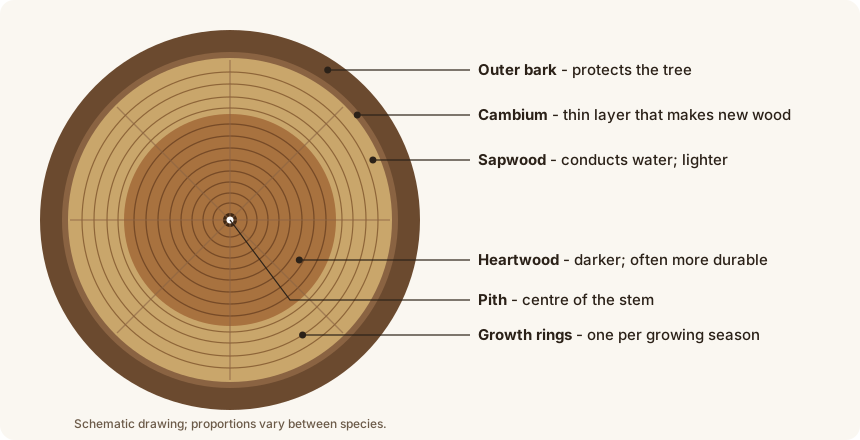
Cross-section of a stem: the cambium, a thin layer under the bark, adds new wood to the outside each season; sapwood is the outer band, heartwood the older inner core, and the pith marks the centre where the tree began.
Reading the cross-section: rings, sapwood, heartwood
Moving from the outside in, bark protects the tree, and beneath it lies the cambium, a very thin growing layer that makes new wood cells inwards and bark cells outwards. In temperate climates it works in seasonal pulses, so each growing year leaves a growth ring. Within a ring, the earlywood formed first has large-diameter cells with thin walls, and the latewood formed at the outer edge has narrow cells with thick walls (Virginia Cooperative Extension, 2024). Because latewood is denser, ring structure translates directly into density. An older edition of the Wood Handbook adds that earlywood is lighter, softer and weaker than latewood, and that latewood proportion is sometimes used to judge strength in southern pines, Douglas-fir and ring-porous hardwoods.
The contrast between the two zones differs by species. In softwoods the transition may be abrupt, as in southern yellow pine, Douglas-fir and redwood, or extremely gradual and even imperceptible, as in white pine and the cedars (both from the Virginia guide); the 2010 Wood Handbook lists southern yellow pine, larch, Douglas-fir, baldcypress and redwood as abrupt and spruce and true fir as gradual.
Toward the centre, the living outer band is sapwood and the inner, older zone is heartwood. Heartwood accumulates extractives that affect colour, aroma and decay resistance (Virginia Cooperative Extension, 2024). Sapwood width varies enormously: the Virginia guide contrasts locust, with a very narrow band, with black cherry, which has very wide sapwood. The older Wood Handbook edition gives a typical sapwood thickness of 4 to 6 cm (1.5 to 2 in.) radially, with some species, such as maples, hickories and ashes, reaching 8 to 15 cm, especially in second-growth trees. Two caveats come from that same text. The change from sapwood to heartwood does not add or remove cells, and the basic strength of the wood is essentially unaffected, so heartwood is not stronger just for being heartwood. And none of the sapwood of any species is resistant to decay.
Green moisture content, expressed on an oven-dry basis, differs between the zones. Table 4-1 of the Wood Handbook moisture chapter (2010 edition, FPL-GTR-190; US species) shows softwood sapwood usually far wetter than heartwood: western redcedar 58% in heartwood against 249% in sapwood, sugar pine 98% against 219%, coast Douglas-fir 37% against 115%. Hardwoods are less consistent: white oak 64% heartwood and 78% sapwood, basswood 81% and 133%, white ash almost equal at 46% and 44%, while cottonwood (162% and 146%) and water tupelo (150% and 116%) are wetter in the heartwood. A kiln charge that mixes sapwood and heartwood boards therefore starts with a wide spread of moisture content.
Softwood cells: tracheids do almost everything
Softwoods (gymnosperms) have a simple structure. According to the Wood Handbook, tracheids make up over 90% of the volume. A tracheid is a long, thin, hollow cell, 1 to 10 mm long and more than 100 times longer than wide, overlapping its neighbours across 20% to 30% of its length at each end. The same cells conduct water in the living tree and carry the mechanical load in the finished board. Axial parenchyma, which stores food, never makes up even 1% of the volume.
Species density still differs widely: the Wood Handbook gives specific gravity 0.59 for longleaf pine and 0.35 for eastern white pine.
Pine, spruce, Douglas-fir and larch also contain resin canals. These are voids, not cells, surrounded by resin-producing parenchyma (Wood Handbook).
Hardwood cells: vessels, fibres and more variety
Hardwoods (angiosperms) split the work between specialised cells. Vessel elements stack end to end into vessels, long conducting tubes, while fibres supply most of the strength. The Wood Handbook gives vessel diameters typically between 50 and 200 micrometres, with small vessels under 30 and large ones over 300 micrometres. Vessel elements are 0.1 to 1.2 mm long; fibres are 0.2 to 1.2 mm long, about half the width of softwood tracheids, and two to ten times longer than vessel elements. The older edition puts average hardwood fibre length at about 1 mm and softwood fibre length at 3 to 8 mm.
The presence of vessels (pores in cross-section) is the simplest field test: softwoods have none, and a 10x hand lens suffices (Virginia Cooperative Extension, 2024). The same guide stresses that softwood and hardwood are taxonomic terms, not statements of hardness. Balsa, a hardwood, has a specific gravity below 0.20, while some tropical hardwoods exceed 1.0 (Wood Handbook).
Ring-porous, semi-ring-porous and diffuse-porous
Hardwoods are classified by how vessel size changes across the ring.
In ring-porous woods such as oak and elm, vessel diameter drops sharply from earlywood to latewood, so the large earlywood pores form a distinct band. In diffuse-porous woods such as yellow-poplar, gum and maple, vessel size is uniform or changes only gradually. Semi-ring-porous woods, such as black walnut, butternut and hickory in the Virginia guide, fall in between (Virginia Cooperative Extension, 2024). The classification is not uniform between sources: the 1999 Wood Handbook names ash, hickory and oak as ring-porous examples, so hickory appears in both classes. The portal did not verify the size of the vessel-diameter drop or how visible the pores are to the naked eye, and offers no figures.
The Wood Handbook links latewood share to strength in ring-porous hardwoods; the sources I opened give no numeric ring-width rules for either class, so none are offered.
Rays and the planes of weakness they create
Rays are ribbons of parenchyma cells running radially from bark toward the pith, moving and storing material horizontally. In softwoods the Wood Handbook describes ray parenchyma cells about 15 micrometres high, 10 micrometres wide and 150 to 250 micrometres long. Most hardwood rays are one to five cells wide and under 1 mm high, but oak and hard maple also have some rays more than eight cells wide that reach centimetres in height.
Rays matter for two reasons. The first is identification: the Virginia guide uses ray height on the tangential face, noting that red oak rays never exceed 1 inch while white oak rays are consistently over 1 1/4 inches, and that yellow-poplar, ash and maple have very narrow rays one to two cells wide. The second is mechanical: the older Wood Handbook edition states that rays are planes of weakness along which seasoning checks readily develop.
How the cut relates to the rings
Ring orientation to the board face governs shrinkage and warp. The Wood Handbook defines plainsawn lumber as having rings at 0 to 45 degrees to the wide face, quartersawn as 45 to 90 degrees, and bastard sawn as 30 to 60 degrees. Tangential shrinkage is about twice radial. Table 4-3 gives green-to-oven-dry shrinkage as a percentage of green dimension (radial, tangential, volumetric): eastern white pine 2.1, 6.1, 8.2; coast Douglas-fir 4.8, 7.6, 12.4; yellow-poplar 4.6, 8.2, 12.7; white oak 5.6, 10.5, 16.3; old-growth redwood 2.6, 4.4, 6.8. Longitudinal shrinkage is only about 0.1% to 0.2% for most species, but reaction wood and juvenile wood can shrink about 2% from green to oven-dry. The shrinkage figures are for US species (Wood Handbook, 2010 edition).
The drying chapter works an example: a 232 mm flatsawn white fir board changes about 1.7 mm in width between 8% and 11% moisture content, using a tangential coefficient of 0.00245 per percentage point of moisture content. It also says radial diffusion is somewhat faster than tangential, so flatsawn lumber dries faster than quartersawn, and that longitudinal diffusion is 10 to 15 times faster than either, which is why end coatings are an effective preventive against end checks.
Drying, density and the sapwood/heartwood split
The drying chapter says lighter species dry faster because their structure has more openings per unit volume, and that sapwood generally dries faster than heartwood because heartwood extractives plug passageways; since heartwood of many species starts at a lower moisture content, both can still reach final kiln moisture in similar time. Air drying to 20% to 25% before kilning saves energy: for 25 mm (1 in.) lumber, about 15 to 30 days for pine, spruce, red alder and soft maple under favourable conditions, but 200 to 300 days for slow-drying species such as sinker hemlock and pine, oak and birch in northern locations at unfavourable times of year (pine appears in both groups in the source, depending on density and conditions). Fibre saturation averages about 30% moisture content, with several points of variation between species and pieces; shrinkage begins below it.
The same chapter lists surface checks on flatsawn faces, end checks, collapse, honeycomb and warp, the last made worse by irregular grain and by juvenile or reaction wood. It gives no separate figures for ring-porous versus diffuse-porous drying, so none are claimed.
Juvenile wood, reaction wood and grain
Wood formed near the pith differs from mature wood. The Wood Handbook says juvenile wood has a higher S2 microfibril angle, linked to drastic longitudinal shrinkage on drying; the lower stiffness that goes with a high angle comes from Donaldson's review, where the effect is strongest in juvenile wood and butt logs (the companion article on cell-wall chemistry explains more). Donaldson's review defines conifer juvenile wood as the inner 10 to 15 rings, with the highest angles in the first five rings at the base of the tree.
A New Zealand study of 25-year-old radiata pine (Haslett and others, 1991) gives a concrete example. Corewood, defined as the first 10 rings, made up 44% of log volume in logs over 400 mm, 50% at 300 to 399 mm, 75% at 200 to 299 mm and 99% at 150 to 199 mm. The boards were high-temperature kiln dried under top weights. Corewood spiral grain was typically 5 to 7 degrees (maximum 18) against about 2 degrees in outerwood. Of the 100 x 50 mm framing, about 35 to 36% of lengths were rejected for twist overall (the abstract and table differ by one point), from 18% for the largest logs to 70% for the smallest. In a 148-length subsample, gauging, meaning dressing to 90 x 45 mm, more than halved twist rejection (38% to 16%); this is a dressing effect, not a log-sorting result. A Swedish study of 190 Norway spruce studs of 45 x 95 x 2500 mm (Johansson and Kliger, 2002) found that grain angle and ring curvature explained 73% of the variation in twist, whereas bow and crook could not be modelled, although compression wood distribution on the faces usually indicated their direction. These are results for particular stands and products, not general rejection rates.
Reaction wood forms when a stem or branch deviates from vertical by more than one or two degrees. Softwoods form compression wood on the underside; hardwoods form tension wood on the upper side. Compression-wood tracheids have a large S2 microfibril angle, high lignin and high longitudinal shrinkage; tension-wood fibres have a gelatinous layer (Wood Handbook).
Species identification at the mill
A short sequence works for most temperate species: pores under a hand lens mean hardwood; then decide the porosity class; check ray width and height on the tangential face; in softwoods look for resin canals and note whether the earlywood-to-latewood transition is abrupt. Colour alone is unreliable.
Practical rules of thumb for sawmills
- Treat the pith as a hazard marker: boards with or near the pith carry juvenile wood, more spiral grain and higher twist risk; sort them separately where product standards allow.
- Track log diameter: in the radiata study corewood share rose steeply as diameter fell, and twist rejection with it.
- Separate sapwood and heartwood in kiln charges where practical, since starting moisture can differ greatly, especially in softwoods.
- Seal the ends of valuable stock: end-grain moisture loss is 10 to 15 times faster than through the sides.
- Expect flatsawn faces to check first and show more width change than thickness change; choose the sawing pattern for the product.
- Look for compression wood on faces: in the spruce study its distribution was the best clue to bow and crook direction.
- Identify species by pores and rays, not colour alone.
What is uncertain or varies
- Sapwood width, moisture content and ring width vary between trees, sites and regions; the figures above are examples. Fibre saturation point varies by several percentage points.
- The sources I read give no figures for resin canal size, sapwood as a share of radius, or drying behaviour by porosity class, so none are stated.
- The corewood and twist numbers come from specific New Zealand and Swedish studies; other species, stands and sawing patterns will differ.
- The Wood Handbook structure and moisture chapters were read in reproductions of the 2010 edition (FPL-GTR-190) and, for some statements, the 1999 edition (FPL-GTR-113); the drying chapter is Chapter 13 of the 2021 edition (FPL-GTR-282). The 2021 versions of the structure and moisture chapters could not be opened, so those values are 2010 values. The 4 to 6 cm sapwood figure, the rays-as-planes-of-weakness statement and the latewood-strength statement come from the 1999 edition and were not found in the 2010 text.
- Ring-porous and diffuse-porous are classes with gradual boundaries; some species are semi-ring-porous.
Key points
- Softwood is over 90% tracheids; hardwood has vessels plus fibres, the quickest field distinction.
- Rings, latewood share and ring orientation set density, figure and shrinkage direction.
- Tangential shrinkage is about twice radial; longitudinal is normally 0.1% to 0.2% but can approach 2% in juvenile and reaction wood.
- Softwood sapwood is usually wetter than heartwood; sapwood is never decay-resistant, but is not weaker for being sapwood.
- Rays are planes of weakness for checking and a key to hardwood identification.
- Juvenile wood, spiral grain and compression wood are the main anatomical causes of warp and downgrade, and small logs contain the most.
How this text was checked · checked 2026-10-26
Each cited source was re-opened (Wood Handbook chapters 2-4 in 1999/2010 reproductions and drying chapter 13, Virginia Cooperative Extension guide, Donaldson review, Haslett et al. 1991, Johansson and Kliger 2002) and numbers, definitions and attributions compared with the text; the 2021 Wood Handbook chapters could not be opened.
Corrections made during checking
- Axial parenchyma: source says it 'never makes up even 1%', not 'about 1%'.
- Sapwood 8-15 cm applies to maples, hickories, ashes in second growth; removed 'or more'.
- Earlywood-latewood transition examples now attributed correctly (white pine/cedars from Virginia guide; Wood Handbook 2010 lists spruce and true fir as gradual, other softwoods abrupt).
- Removed unsupported 'order of magnitude' vessel-size drop and naked-eye/hand-lens visibility claims; added that hickory is classed differently in different sources.
- Removed unsupported caution about white fir example over/underestimating widths; replaced with the coefficient actually used.
- Air-drying times: 200-300 days applies to sinker hemlock, pine, oak and birch in northern locations at unfavourable times; pine appears in both groups.
- Juvenile wood stiffness effect re-attributed to Donaldson (Wood Handbook only links high S2 angle to longitudinal shrinkage).
- Haslett: corewood shares are volume percentages; overall twist rejection is 35-36%; the 38%->16% result is from gauging/dressing to 90x45 mm, not log sorting; drying was high-temperature kiln.
- Johansson & Kliger: stud size and Swedish origin added.
- Edition statement fixed: 2010 (GTR-190), 1999 (GTR-113), and 2021 (GTR-282 ch. 13); data labelled as US/NZ/Sweden.
Could not be verified
- Statements in the 2021 Wood Handbook chapters 3-4 (not opened).
- Rays as planes of weakness, 4-6 cm sapwood and latewood-as-strength-indicator statements rest on the 1999 edition only.
- Size of vessel-diameter drop in ring-porous woods and naked-eye visibility of pores: not in opened sources and not given.
- Whether Haslett's overall twist rejection is 35% or 36% (abstract vs table differ).
Sources
- Wood Handbook chapter 'Structure and Function of Wood' (reproduction, CED Engineering)
- Wood Handbook FPL-GTR-113 (1999), Chapters 2 and 3 (reproduction, CED Engineering)
- Wood Handbook chapter 'Moisture Relations and Physical Properties of Wood' (reproduction, CED Engineering)
- Wood Handbook drying chapter, 'A Guide to Wood Drying, Moisture Content and Dimensional Changes' (reproduction, CED Engineering)
- Bond, B. and Rappold, P. 'Wood Identification for Species Native to Virginia' (Virginia Cooperative Extension, ANR-64P, 2024)
- Donaldson, L. 'Review - Microfibril angle: measurement, variation and relationships' (Scion)
- Haslett, Simpson and Kimberley 'Utilisation of 25-year-old Pinus radiata. Part 2: Warp of structural timber in drying' (NZ J. For. Sci. 1991)
- Johansson and Kliger 'Influence of Material Characteristics on Warp in Norway Spruce Studs' (Wood and Fiber Science, 2002)
Last updated 2026-10-26