Wood science
Wood Anisotropy: Shrinkage and Swelling in the Longitudinal, Radial and Tangential Directions
Why wood shrinks about twice as much tangentially as radially and hardly at all along the grain, with Wood Handbook values for common species, the proposed causes, and how this drives cup, bow, crook, twist and checking, and how flat-sawn, quarter-sawn and live-sawn boards behave.
Country / region of the study or data: North America (USDA Wood Handbook shrinkage data; US extension sources); China (Xue et al. test samples); Scots pine cell-wall study (Gu et al.) not region-specific. No European tables verified.
Why this matters in the sawmill
Wood does not shrink equally in all directions, and a sawmill decides, with every cut, which of those directions ends up as the width, the thickness and the length of a board. Two boards from the same log, dried to the same moisture content, can leave as one flat and one cupped, simply because their growth rings sat at different angles to the faces. Understanding the geometry lets you predict what a sawing pattern will do and choose it for the product.
The three directions of wood
A tree stem is organised around its axis. The longitudinal direction runs along the grain, parallel to the stem and to most of the cell axes. Across the grain there are two further directions, defined by the growth rings: the radial direction runs from the pith outwards, across the rings, and the tangential direction runs along a ring, at a right angle to the radius, parallel to the growth-ring boundary. A board's width can be tangential, radial or in between, depending on the cut.
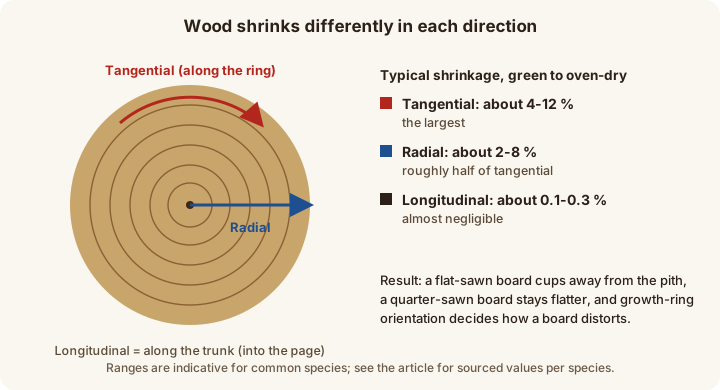
Shrinkage differs strongly by direction: roughly twice as large along the growth rings (tangential) as across them (radial), and very small along the grain (longitudinal).
Shrinkage and swelling happen because the cell wall changes volume as bound water leaves or enters it. The Wood Handbook (USDA Forest Products Laboratory, chapter 4, read as reproduced by CED Engineering) assumes shrinkage starts at about the fibre saturation point and proceeds linearly as moisture content falls; if the fibre saturation point of a species is unknown, 30 % moisture content can be used as an approximation. Chapter 13 (Bergman) likewise assumes shrinkage starts at 30 % MC for all species except those footnoted in its table, for which it uses 22 %.
Typical shrinkage values and their sources
The most widely used reference values are the green-to-oven-dry shrinkage figures in the Wood Handbook (Table 4-3 in the edition we read), expressed as a percentage of the green dimension. A selection:
| Species | Radial, % | Tangential, % | Volumetric, % | T/R ratio (our calculation) |
|---|---|---|---|---|
| Bur oak | 4.4 | 8.8 | 12.7 | 2.0 |
| Sugar maple | 4.8 | 9.9 | 14.7 | 2.1 |
| Black walnut | 5.5 | 7.8 | 12.8 | 1.4 |
| Yellow-poplar | 4.6 | 8.2 | 12.7 | 1.8 |
| Eastern cottonwood | 3.9 | 9.2 | 13.9 | 2.4 |
| Loblolly pine | 4.8 | 7.4 | 12.3 | 1.5 |
| Douglas-fir (coast) | 4.8 | 7.6 | 12.4 | 1.6 |
| Sitka spruce | 4.3 | 7.5 | 11.5 | 1.7 |
| Western redcedar | 2.4 | 5.0 | 6.8 | 2.1 |
| Redwood (old growth) | 2.6 | 4.4 | 6.8 | 1.7 |
Source: USDA Forest Products Laboratory, Wood Handbook chapter 4 (values as reproduced in the CED Engineering course adaptation). The last column is our own division and not a published figure. Mitchell (BioResources, 2016), citing the same handbook, gives 11.3 % tangential and 4.7 % radial for southern red oak (also in Table 4-3), a ratio of about 2.4. All of these are North American species.
Three things stand out. First, tangential shrinkage is always larger than radial, but the ratio is not exactly two: in this selection it runs from about 1.4 to 2.4. Spear and Walker (2006), cited by Xue and co-authors (2018), put the usual range at 1.5 to 2.5. "About twice" is a good rule of thumb and a poor precision claim. Second, the handbook notes that, in general, greater shrinkage is associated with greater density, which fits the low values of the light western redcedar and redwood. It is only a general tendency: eastern cottonwood is a light hardwood but has a high tangential value (9.2 %) in the table, so density alone does not predict shrinkage. Third, green to oven-dry is an extreme that real products never reach; in service the change is a fraction of these numbers.
Extension sources give rounded ranges, all for North American conditions: Wengert and Meyer (University of Wisconsin, 1993) 4-6 % radial and 6-12 % tangential for North American species; Conners (University of Kentucky) roughly 3-4 % radial and 6-8 % tangential, with radial about half of tangential.
The longitudinal direction
Along the grain, shrinkage is tiny. The handbook gives average values between 0.1 % and 0.2 % from green to oven-dry for most species, and Wengert and Meyer say normal mature wood shrinks less than 0.1 % along the grain from green to kiln-dry, so a ten-foot board loses less than an eighth of an inch in length. The exceptions matter in a sawmill: the handbook notes that reaction wood and juvenile wood can shrink about 2 % along the grain from green to oven-dry (Wengert and Meyer name compression wood, tension wood and juvenile core wood as the high-longitudinal-shrinkage woods), and cross grain increases longitudinal shrinkage too. That ten- to twenty-fold difference (our arithmetic: 2 % against 0.1-0.2 %) in longitudinal shrinkage inside one board is what produces bow, crook and twist.
Putting numbers on a board
Take a flat-sawn bur oak board 200 mm wide when green, dried to 8 % MC. With the handbook's linear assumption from 30 % (which Bergman says tends to underestimate the true change by about 5 % of the change), tangential shrinkage is about 8.8 % x (30 - 8) / 30, or 6.5 %, which is about 13 mm. A quarter-sawn board with the same green width would lose about 4.4 % x 22 / 30, or 3.2 %, about 6.5 mm. This is our illustration of the handbook method, not a measured result; individual pieces vary, with the handbook quoting a coefficient of variation of approximately 15 % for transverse and volumetric shrinkage. Bergman (handbook chapter 13, Table 13-5) gives dimensional-change coefficients per percentage point of MC for white fir of 0.00245 tangential and 0.00112 radial, a ratio of 2.2 (our division; this is a North American species).
Why tangential is roughly twice radial
The honest answer is that wood scientists have several overlapping explanations and no single accepted winner. Xue and co-authors (BioResources 13(3), 2018) group the proposals under three headings, and the same grouping is useful for a sawmill reader:
- Ray restraint. Rays are ribbons of cells running radially, and the idea is that they hold the radial dimension back. Xue and colleagues, studying oak (Quercus sp.), black walnut and Pometia pinnata (a diffuse-porous species), all from Zhejiang Province, China, found that fibres next to rays shrank least (with an exception, the latewood of black walnut), consistent with restraint, but their conclusions state that ray width had no negative correlation with the shrinkage of neighbouring fibres, so restraint is not a complete explanation.
- Earlywood and latewood. Xue and colleagues report that latewood shrinks more than earlywood, which increases tangential shrinkage; earlywood has less wall material and is forced to shrink together with the latewood.
- Cell wall structure. Xue and colleagues list this third group as the microfibril angle in the S2 layer. Gu, Zink-Sharp and Sell (Holz als Roh- und Werkstoff, 2001) studied Scots pine sapwood tracheids with electron microscopy. They found that the radial wall of latewood cells is about 25 % thicker than the tangential wall (no such difference in earlywood), and that the S2 fibrils on both walls show a significant tendency towards a preferred orientation or higher packing density in the tangential direction. They suggest that this structure "might explain" the anisotropic transverse shrinkage "to a major extent", while stating that some wall phenomena are not yet clearly understood. These findings are for one softwood species.
For practical purposes you do not need to settle the debate. You need the consequence: the ring-following direction moves about 1.5 to 2.5 times as much as the ring-crossing direction, and the exact ratio depends on species and on the piece.
How anisotropy turns into cup, bow, crook, twist and checks
Wengert and Meyer state that all warp is caused by differential directional shrinkage as the wood dries from its green state. Bergman lists six warp types: bow, crook, twist, oval, diamond and cup. He traces warp to two causes, differential shrinkage and growth stresses, and says irregular grain and juvenile or reaction wood aggravate it; he does not assign a separate cause to each type.
Cup. The classic anisotropy defect. In a flat-sawn board the rings run roughly parallel to the wide faces. The face nearer the bark is the more tangential one, and the face nearer the pith is more radial, because the rings curve. In our geometric reasoning (not a statement from the sources), the bark-side face therefore shrinks more across its width than the pith-side face. Mitchell and Wengert and Meyer both state that flat-sawn lumber cups toward the bark side (away from the tree centre), and Mitchell adds unless restrained. Mitchell's model predicts that flat-sawn lumber cut near the pith cups more than similar lumber cut near the bark (in his oak examples the predicted cup rose more than threefold toward the pith), and that lumber from small-diameter trees is more cup-prone. His quarter-sawn loblolly pine model showed minimal cup; these are unrestrained worst-case model predictions, not measurements.
Bow and crook. These are length-wise curvatures, driven mainly by longitudinal shrinkage differences: bow along a face and crook along an edge. Wengert and Meyer attribute them to juvenile wood, compression or tension wood, and sloping or cross grain, which shrink far more along the grain than mature wood. Sawing pattern strongly affects crook: Wengert and Meyer say quarter-sawn lumber is the most susceptible because one edge lies closer to the centre of the tree, and they advise keeping the rings centred edge to edge. Conners adds that juvenile wood (the first 10 to 15 growth rings around the pith) shrinks more than mature wood, so a board with one edge nearer the pith develops side bend.
Twist. Conners links twist to spiral grain in the log and notes that species with interlocked grain, especially the gums and sycamore (his list also includes beech), are hard to dry flat.
Checking. Surface checks form early in drying when the shell goes into tension while the wetter core resists shrinking (a general drying mechanism that we did not re-check in a cited page); Bergman says they occur most often on the face of flat-sawn boards. End checks are linked by our reasoning to fast end drying: Bergman gives bound-water diffusion along the grain as about 10 to 15 times faster than radial or tangential diffusion, although he adds that this is generally not of practical importance in lumber many times longer than thick, and that end coatings on logs or green lumber are an effective preventive measure. Conners names oaks, beech and sycamore as checking-prone species because of their broad rays, which are planes of weakness running in the radial direction.
How sawing pattern changes board behaviour
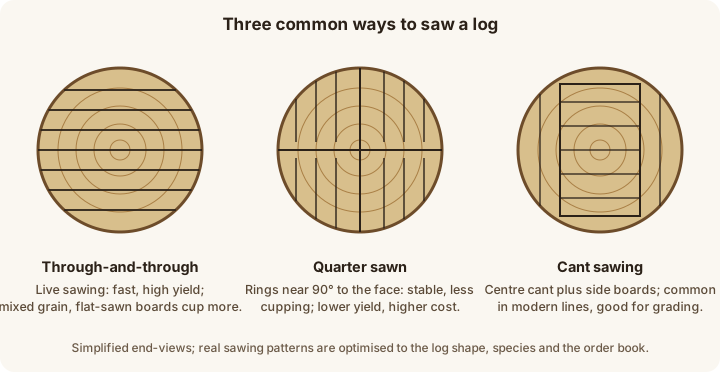
Where a board sits in the log decides its ring angle: flat-sawn boards show rings near parallel to the wide face, quarter-sawn boards show rings near perpendicular to it.
Flat-sawn (plain-sawn). Conners puts the rings at 0 to about 35 degrees to the wide face. Width shrinks tangentially and thickness radially, giving the highest width movement, the greatest cup tendency and the most surface-check risk. Flat-sawn lumber generally dries faster than quarter-sawn (Conners; Bergman).
Quarter-sawn. Rings run at 65 to 90 degrees to the wide face (Conners). The width shrinks radially and the thickness tangentially, so, according to Conners, the shrinkage of the wide face is about one-half that of flat-sawn stock; cup is suppressed (our inference from the geometry, supported by Mitchell's model). Drying is slower. Conners says quarter-sawn lumber is sometimes preferred for flooring. Its weakness is crook sensitivity, as noted below.
Rift-sawn falls in between (Conners).
Through-and-through (live sawing). The log is sawn in parallel cuts without turning. By our geometric reasoning (none of the cited pages describes through-and-through sawing), the boards near the middle of the log have rings nearly perpendicular to the faces and behave like quarter-sawn stock, while boards toward the outside show nearly parallel rings and behave like flat-sawn stock. A through-and-through batch would therefore contain the whole range, with the outer boards the most cup-prone. Boards that include the pith carry juvenile wood, which shrinks more along the grain (Conners; Wengert and Meyer name juvenile wood as a cause of bow), but we found no source stating a rate for pith boards. Wengert and Meyer recommend turning the log through 180 degrees after sawing the first face, so the rings stay centred from edge to edge and crook is reduced.
Cant sawing. The log is squared into a central cant that is then resawn. Our sources do not detail it; the ring angle of each board follows from the same geometry, set by how the cant is oriented.
Ripping. Narrow boards ripped from a wide flat-sawn board are off-centre relative to the original rings and become crook-prone (Wengert and Meyer).
For design calculations, the handbook says to use tangential shrinkage for the width of flat-sawn material and radial shrinkage for quarter-sawn, and to use tangential values when ring orientation is mixed or unknown. Bergman adds that commercial lumber is often not perfectly flat-sawn or quarter-sawn, so this procedure will probably overestimate width shrinkage and underestimate thickness shrinkage.
Practical rules of thumb for sawmills
- For a flat-sawn board, expect width movement of roughly twice that of a quarter-sawn board of the same species, and plan for it in the stated tolerances.
- Use tangential values to estimate width change when the ring orientation is unknown; use species-specific tables where possible, and accept about 15 % scatter between pieces.
- Keep grain parallel to board edges, and keep the pith out of boards where flatness matters.
- Treat cup as mainly a sawing-pattern problem. Wengert and Meyer note that warp usually occurs at high moisture contents (above 40 % MC), and that loading the stack with at least 150 lb/sq ft (about 7 kPa) for three days after drying can reduce cup.
- Match pattern to product: quarter-sawn or rift-sawn where stability matters, flat-sawn where movement is acceptable.
- Where you can, dry flat-sawn and quarter-sawn stock in separate charges; Conners and Bergman say they dry at different rates (flat-sawn faster), and the separation is our practical inference.
- Coat ends of valuable stock to limit end checks (Bergman).
What is uncertain or varies
- The shrinkage values here are North American species from a US handbook. We did not open comparable authoritative tables for European species such as Norway spruce, Scots pine, beech or European oak (a further search on 2026-10-26 found no open authoritative table), so we make no numerical claims for them; the physical principles are the same, but the numbers differ by species.
- The tangential-to-radial ratio of "about two" is a central tendency. In this article's selection it spans 1.4 to 2.4, and a cited review gives 1.5 to 2.5.
- The cause of the anisotropy is still debated, and the 2018 BioResources study reported cell wall shrinkage in some panels above the fibre saturation point, which its authors explain as an inference (shrinkage of the middle lamella) that needs further study; it challenges the assumption that shrinkage starts only below that point.
- The linear shrinkage method is an approximation: Bergman says its error is in the direction of underestimating dimensional change, by about 5 % of the true change.
- Reaction wood, juvenile wood and grain angle can make a board behave unlike its species average.
- We found no measured warp rates for through-and-through or cant sawing; those descriptions follow from geometry and the cited extension sources.
Key points
- Wood shrinks very little along the grain (about 0.1-0.2 % green to oven-dry per the Wood Handbook), moderately across the rings (radial) and about twice as much along them (tangential).
- Typical green-to-oven-dry values: tangential 7.4-9.9 % and radial 3.9-5.5 % for the temperate species in the table above, lower in western redcedar and redwood; the tangential/radial ratio ranges from about 1.4 to 2.4.
- Ray restraint, earlywood-latewood interaction and cell-wall structure are proposed causes; none alone is complete.
- All warp comes from differential shrinkage: cup from the tangential-radial difference across the width, bow, crook and twist from longitudinal differences linked to juvenile wood, reaction wood and grain.
- Flat-sawn boards move most in width, cup most and check most; quarter-sawn boards move about half as much in width but dry more slowly and are more crook-prone.
- Choose the sawing pattern for the product; use tangential values for width estimates when ring angle is unknown.
How this text was checked · checked 2026-10-26
Re-opened the CED Engineering reproductions of Wood Handbook chapters 4 and 13, the Conners and Wengert and Meyer extension pages, Mitchell and Xue et al. (BioResources) and the Gu et al. abstract, and compared every number and attribution with the article text.
Corrections made during checking
- Table 4-3 values and southern red oak (11.3/4.7) confirmed unchanged; statement 'dense hardwoods shrink more' softened because eastern cottonwood is light but has high tangential shrinkage.
- Bergman's 10-15x figure is bound-water diffusion, not general moisture movement, and he calls it of little practical importance in long lumber; end-check link now marked as our reasoning.
- Bergman does not assign causes per warp type; he names two causes (differential shrinkage, growth stresses) plus aggravating factors. Text corrected.
- Bergman says lumber is 'often not perfectly' flat- or quarter-sawn, not 'neither'; corrected.
- Xue et al.: 'tropical hardwood' replaced by Pometia pinnata (diffuse-porous; source does not say tropical); walnut latewood exception added; third mechanism is S2 microfibril angle; mid-lamella explanation of above-FSP shrinkage marked as the authors' inference.
- Gu et al.: authors say structure 'might explain' shrinkage 'to a major extent'; latewood-only wall-thickness difference and sapwood specified.
- Crook: Wengert and Meyer say quarter-sawn is most susceptible; the claim that crook is 'most affected' by pattern and that flat-sawn is 'least likely' was removed.
- Through-and-through sawing, cup mechanism by face and pith-board claims are not in the cited pages; relabelled as our geometric reasoning. Mitchell's cup-near-pith and small-tree findings added.
- Wengert and Meyer: warp 'usually' above 40 % MC; shrinkage ranges labelled North American; Conners half-shrinkage refers to the wide face; reaction-wood 2 % is handbook 'about 2 %'.
- Added Bergman's 22 % start-of-shrinkage footnote and handbook 30 % approximation wording.
Could not be verified
- Surface-check mechanism (shell in tension, wet core) not re-checked in a cited page.
- No open authoritative shrinkage table for European species was found (Norway spruce, Scots pine, beech, European oak).
- Cant sawing behaviour and through-and-through warp rates: no source.
Sources
- Wood Handbook, Chapter 4: Moisture relations and physical properties of wood (USDA Forest Products Laboratory; course reproduction by CED Engineering)
- Bergman, A Guide to Wood Drying, Moisture Content and Dimensional Changes (Wood Handbook chapter 13; CED Engineering adaptation)
- Conners, Hardwood Dry Kiln Operation: A Manual for Operators of Small Dry Kilns (University of Kentucky)
- Wengert & Meyer, Causes and Cures for Warp in Drying (University of Wisconsin Forestry Facts No. 68, 1993; WOODWEB)
- Mitchell, Modeling lumber cupping (BioResources 11(3), 2016)
- Xue et al., Effects of Wood Rays on the Shrinkage of Wood during the Drying Process (BioResources 13(3), 2018)
- Gu, Zink-Sharp & Sell, Hypothesis on the role of cell wall structure in differential transverse shrinkage of wood (Holz als Roh- und Werkstoff 59, 2001), record
Last updated 2026-10-26